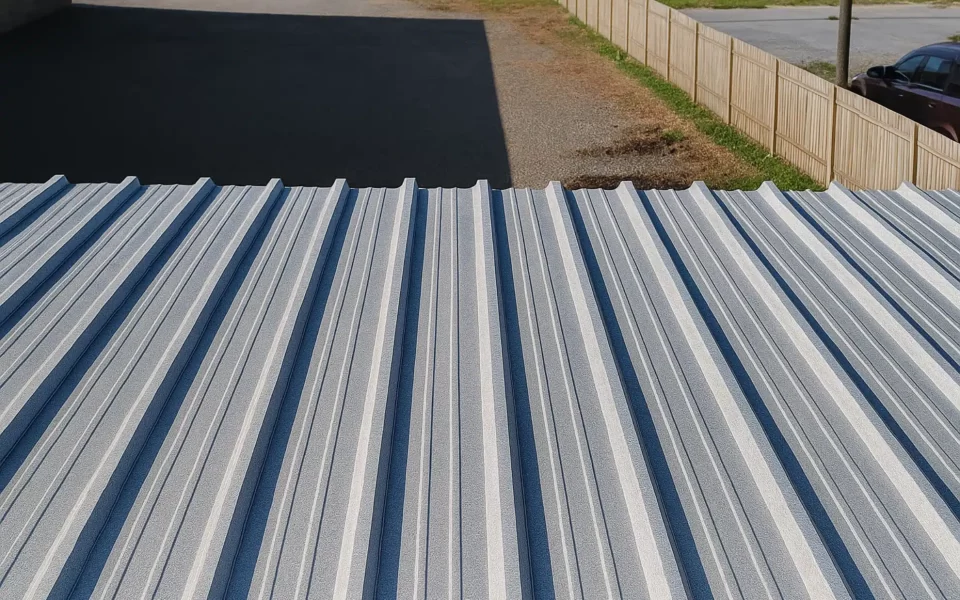
Roof coating is a monolithic, fully adhered, fluid-applied roofing membrane. It has elastic properties that allow it to stretch and return to their original shape without damage.
Typical roof coating dry film thickness varies from paint film thickness (plus or minus 75 dry microns) to more than 1000 dry microns. This means a roof coating actually becomes the top layer of a composite roof membrane and underlying system. As such, the roof coating is the topmost layer of protection for the membrane, receiving the impact of sunlight (both infrared and ultraviolet (UV)), rain, hail and physical damage.
Roof coatings should not be confused with deck coatings. Deck coatings are traffic bearing – designed for waterproofing areas where pedestrian (and in some cases vehicular) traffic is expected. Roof coatings will only waterproof the substrates but will not withstand any kind of ongoing use by people or vehicles (such as walkways, patios, sundecks, restaurants, etc.).
Benefits:
- Excellent resistance to blistering under extended ponded water conditions.
- Excellent adhesion to asphaltic roofing substrates including new and aged built-up asphalt and modified bitumen.
- A barrier to ultraviolet light which prevents degradation of the roofing substrate.
- Significantly lower roof surface temperatures which can help reduce cooling bills.
- Resistance to asphalt staining (“bleed through” resistance).
- Excellent dirt pick-up resistance.
- Excellent flexibility at temperatures as low as 0°C or 32°F (below the temperature at which unmodified asphalt becomes brittle).
- Application by spray, brush or roller.
- 40 g/liter volatile organic components (calculated).
- User-friendly (soap and water clean-up), environmentally friendly.
- Wet adhesion improvement over standard elastomeric coating.
- Coating durability after 1-year exposure (continuous immersion for 6 months).
- Roof coatings are seamless and when installed correctly, can solve roof leaks on almost any type of roofing material.
There are exceptions: professionals do not recommend using cool coatings over existing shingles. This technique can cause moisture problems and water damage because the coating can inhibit normal shingle drying after rain or dew accumulation, allowing water to condense and collect under the shingles.
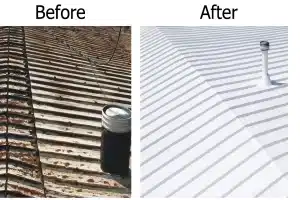
Field-applied reflective roof coatings can extend the useful life of nearly every roof substrate keeping a roof surface cool and providing a level of protection from the sun and weather.
However, coating asphalt shingles and built-up composition roofs requires more caution. The roofing industry is aware of a number of issues that could have negative consequences for field application of coatings over asphalt shingle roof systems. Anyone considering this type of application should be aware of the concerns so they can weigh them against the benefits claimed in coating product promotional materials.
Roof coatings can add 25 years to the service life of a roof and reduce the amount of discarded roofing materials that end up in landfills. The infrared image shows 79°C on the uncoated (black) section of the modified bitumen roof. The coated (white) section is 26°C. Field studies have shown that cool roof coatings can lower rooftop temperatures and reduce air conditioning bills.
Mechanical Properties
Mechanical properties demonstrate the relationships among tensile strength, elongation and installed film thickness. The trend clearly shows that when elongation increases, tensile strength decreases as the film thickness is increased. This flexibility is important because roofs tend to expand and contract with building movement, changes in temperature and thermal shocks caused by severe weather. In these situations, it is important for the coating to move with the roof and not provide any routes for the sun to attack the surface underneath. Also, if a crack were to form in the substrate, the coating would be expected to bridge the crack and continue to provide a seamless surface. While a coating at 500 dry microns will stretch by almost 200% in this case, it is important to note that at 125 dry microns, the same coating will only have about 140% elongation. Keep in mind that ASTM D6083 requires conducting all mechanical testing with films that have a dry film thickness of 500 microns +/- 50 microns. This provides a level playing field for the evaluation of different coatings, but is not always consistent with what will be installed on a roof.
Proper Hiding
 Another key reason for proper film thickness is to effectively protect the roof
substrate from harmful solar ultraviolet (UV) rays. These rays, which make up only about 10% of the energy from the sun, cause most of the degradation in the roofing membranes coatings which are designed to protect. The main opacifier in an elastomeric roof coating is titanium dioxide (TiO₂), which works by efficiently scattering the sun’s energy and blocking it from reaching the substrate. However, this can only be accomplished by having enough UV blockers present to prevent the UV energy from reaching the substrate. A quick test of this theory can be run by making drawdowns of various thicknesses over black surfaces. You will see that at lower film thicknesses, the black surface will show through the coating and make the white coating appear gray. At higher film thicknesses, this effect will disappear as the coating completely hides the surface below it.
Weathering Effect:
A fact of life in the roofing business is that all roofs will fail over time due to weather effects and exposure to the sun’s UV rays. In this respect, acrylic elastomeric roof coatings are no different than EPDM, asphalt or thermoplastic sheets – over time, the elements will take their toll by breaking down the chemical components. In elastomeric roof coatings specifically, the UV energy from the sun will slowly break down the acrylic resin over time and microscopic layers of the coating will slowly wash away.
Coatings applied at greater thicknesses have proven to perform better over the long term. The application done at various thicknesses at 125, 250, 375 and 750 microns for a standard ARM-91-1 coating over polyurethane foam shows that the coating applied at 125 dry microns did not adequately protect the foam from the sun, and consequently the foam broke down into a powder.
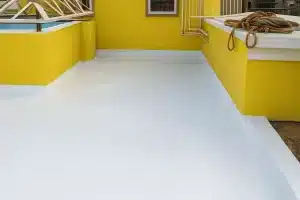
This process had begun in the 250 microns and 375 microns samples, as is evidenced by the holes forming in the samples. On the other hand, after 12 years, the 750 dry microns sample was still unmarred and providing protection to the foam below. These examples illustrate why a thicker membrane or coating is expected to withstand the elements for a longer period of time, and why thickness is often the main driver in warranty length for many different types of roofing systems.
Acrylic Elastomeric Reflective Roof Coatings
Acrylic polymers have now been specifically designed for roofing applications. Back in the 1980s and even into the 1990s, mistakes were made when house paints were applied on roofs. The results were disastrous because these house paints were much too brittle. Others tried to use caulk and sealant technology to make elastomeric roof coatings, thinking that because they are “soft” they will work. The properties needed for a roof coating far exceed just whether the coating is harder or softer. Expectedly, using caulks or adhesives as a roof coating also met with abysmal failure. Today the technical requirements for a successful roof coating are fully understood and, in most cases, the proper acrylic polymer is used for the proper end use. Acrylic elastomeric roof coatings are liquid-applied, seamless, fully adhered membranes that are formed in situ on the roof. These coatings are applied 6 to 8 times thicker than house paint. Typically, the thickness of exterior house paint is 75 dry microns, or 0.003 inches. For elastomeric roofing applications, the application rate is typically 400–500 dry microns minimum, with higher quality installations being applied at 750 dry microns or more. Some installations are coating-only; while others will combine a variety of fabric designs into the coating matrix, literally creating a membrane on the roof. Competing products known as single-ply membranes are created in a factory, and then applied to a roof. For example, products like PVC, EPDM or TPO are often supplied in sheets 1125 microns or thicker. Unlike these single-ply materials, the acrylic roof coating has no seams. Additionally, it is also fully adhered; not requiring mechanical fasteners or adhesives as do single-ply membranes.
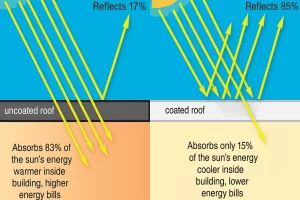
Most acrylic elastomeric roof coatings are white or near-white in color. The whiteness of the coating provides two very important features. First, it reduces the temperature of the roof surface and, more importantly, to the membrane to which it is applied. This reduced temperature, coupled with the UV blocking properties of the coating, reduces the rate of degradation and deterioration of the underlying roofing membrane. Second, the white color reflects as much as 95 percent of the heat portion of the sunlight, reducing the heat transferred into the building and thus reducing the air conditioning costs for that building. For most industrial applications, white acrylic elastomeric roof coatings are the perfect choice because most of these buildings have horizontal, or flat, roofs. The high brightness and reflectivity of the coatings is ideal for reflecting the sun’s energy back into outer space. For residential applications, however, some structures have sloped roofs and the high brightness of the coating would be undesirable. For this reason, residential roof coatings are usually tinted to a medium to deep tone color and are rarely elastomeric technology.
Be Flexible
A roof is not a static structure, meaning that a roof is constantly expanding and contracting with temperature and humidity fluctuations, seismic expansion, the weight of snow and rain loads, wind uplift and even vibrations of the building. The roof coating must also tolerate resistance to foot traffic and even dropping of tools and equipment on the coating. Remember there are many types of equipment that can be located on a roof, including HVAC units, cooling towers, satellite dish antennas, ventilation and cooling ducts, and so on.
Flexibility does not just mean being stretchy. Bubble gum is stretchy but quite inappropriate as a roof coating. The point is that other elastomeric type products might be flexible, but totally inappropriate for roofing applications. Caulks, sealants, adhesives, and even elastomeric wall coatings would be completely inappropriate for use as a roof coating. This is because these products are not designed to have the resistance to standing water or impact and would not be able to retain solar reflectivity properties as needed to maintain cool roof performance.
Save More Than Energy
It’s no surprise that reflective roof coatings remain the fastest-growing product segment in the fluid-applied roofing market. Cool roof coatings can lower energy consumption—a key goal of state and central regulators—as well as meet more stringent cool roof performance requirements in the building codes.
While it’s true that the high solar reflectivity and emittance of white elastomeric coatings can cut down on air conditioning costs, these products do a lot more than just save energy.
White elastomeric coatings can restore, protect and beautify most waterproofing systems and prolong the life of almost any low-slope roof, including metal. Even contractors who have shied away from selling restorative roof coatings are seeing the opportunities. Some have even begun installing these products themselves rather than subbing them out to coatings specialists.
The benefits of today’s cool roofing coatings are more than a few microns deep, and reflectivity is often just the beginning of even more dramatic waterproofing performance.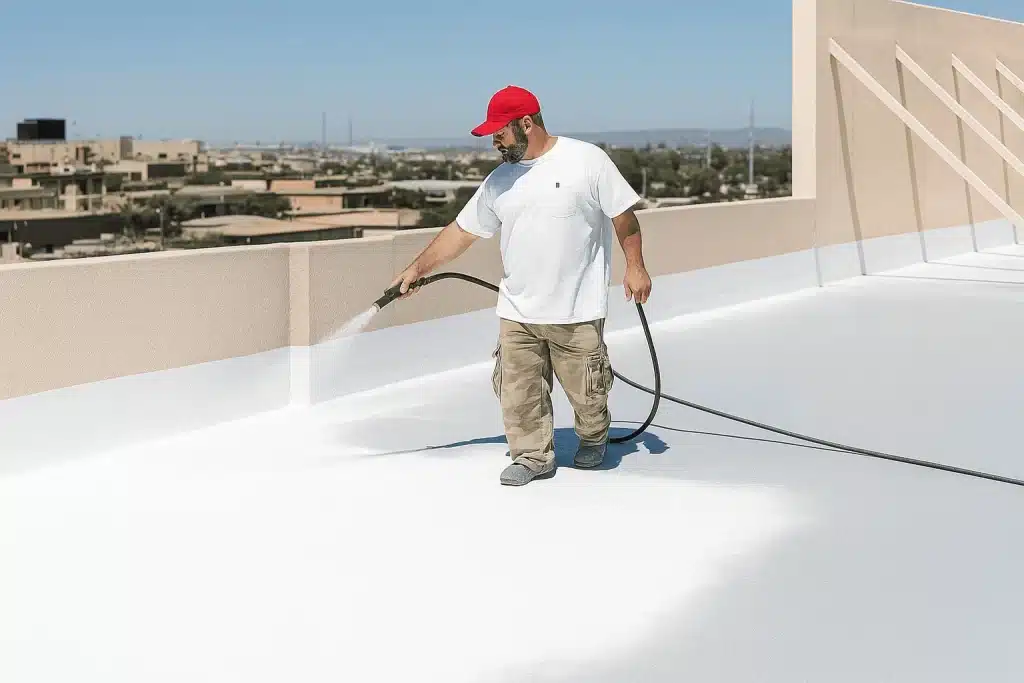
The cool roof coatings market is primarily made up of white elastomeric products and, to a lesser degree, colored coatings that contain infrared reflective pigments. Solvent-based elastomeric, polyurethanes and polyurea’s all serve similar functions, but there are distinct differences between these products in terms of application, performance and price.
For the roofing contractor, material cost and warranty are the key selling points when considering a cool roof coating. “With one acrylic elastomeric (coating) selling at and another at twice that price, the difference comes down to the percentage of solids in the material,”
Roof coatings manufacturers agree that a product with 66 percent to 72 percent solids is a good choice for low-slope roofing. In fact, coatings with a high solids content of 70 percent or more can often be warranted for up to 20 years.
Of course, longer warranties require certified installers who can count on strong technical support and inspections from the coating’s manufacturer. This also assures the architect and property owner that the contractor has been well-trained to install the product.
A well-designed coating, regardless of color, should also be resistant to dirt pickup and be reasonably receptive to cleaning when fully cured. Yet the very properties that allow the membrane to remain pliable through cyclic temperature and climatic changes can undermine this, particularly with lighter colors and in low-slope situations. Dirt pick-up is an issue with any white roof surface, no matter what its makeup. This is best remedied by initiating a semi-annual maintenance program that includes thorough cleaning, inspection and repairs.
With the growing emphasis placed on reducing building energy usage, cool roofs have been playing a more prominent role in helping facility managers and building owners achieve substantial energy savings. Additionally, there are a number of building code changes that now require the use of reflective roofs.
As legislators, architects and property owners embrace the idea that building design has a large impact on energy consumption and sustainability, they are also recognizing that white coatings offer big benefits with few drawbacks.
Energy efficiency initiatives are promoting the use of cool roofs, which may lead to substantial energy savings. In addition, some building codes are now requiring the use of reflective roofs.
If anything, the green building movement is gaining strength every year and raising awareness of the benefits of reflective roof coatings. More generally, environmental awareness of global warming is also raising interest in cool roofs.
With regard to retrofit applications, the cost-effectiveness, proven performance, ease of application, and sustainability of metal roof coatings is another important factor driving demand.
When applied to metal roofing, coatings can perform several important functions, ranging from aesthetic to weatherproofing. Coatings offer a choice of color, protection against moisture intrusion, potential energy savings, and structural enhancement, all at a reasonable cost.
 Without question, lowering energy use is not the only benefit that accrues from the use of cool roof coatings. White coatings can extend the life expectancy of many different types of commercial roofing systems simply by avoiding the high roof temperatures associated with exposure to the sun.
The technical term for this exposure is “insolation,” and it is measured in terms of the rate of solar radiation received per unit area (typically expressed in Watts per square meter). Under clear skies, up to 1,220 W/m² of solar radiation reaches the rooftop. Heavily insulated roof systems block this radiation from penetrating the building as heat; however, in summer months, convective heat transfer to the surrounding air and radiant heat transfer are inefficient. Consequently, the heat has nowhere to go and roofing membrane temperatures can soar.
In fact, an infrared thermometer measured a significant reduction in temperature on the roof at the Jewish Association for Services for the Aged after just one application of Topcoat roof coating.
Most people appreciate that white coatings result in savings on cooling costs, but enhanced roof longevity, especially in northern states, can be another major benefit that results in at least as much savings. Without white coatings, roof temperatures can soar in the summer months, especially for buildings in northern climates. This is primarily because these roof systems typically have a lot of insulation to retain the heat during the winter months.
Coatings can also prevent premature roof deterioration by providing a “sacrificial” layer to take the punishment that the elements and the environment dole out.
Coatings can also waterproof and extend the lives of older roofs. Roof coatings can protect the integrity of a metal roof by reducing thermal-shock roof damage. A cool roof coating moderates the excessive thermal expansion and contraction that otherwise could lead to fastener and seal failures.
According to the Associated Press, “The storm produced so much hail it looked like a snowstorm had hit.”
Unfortunately, the storm also zeroed in on a property owner with six large metal buildings spread out over a half-mile area.
Opportunities for Contractors
Cool roof coatings are growing exponentially, particularly in the metal roof restoration market. “These products are capturing the repair segment of the roofing market and beginning to corner the energy efficiency retrofit demand as well,” said Luke Sutton, owner of Longhorn Construction, a roofing company in Texas. “As word has spread, building owners are deciding to have their roofs coated even when they are still sound, because they want to extend the lives of their existing roof systems.”
When calling on facilities managers, many are eager to engage in a dialogue about metal roof restorations. One of the contractor’s largest customers has installed “thousands of squares of white roof coatings this year, with ten thousand more squares to go.”
Especially in the current economy, commercial building owners are deferring major capital expenditures in favor of sure-fire ways to keep using what they have. They consider a metal roof coating to be the next best thing to an entirely new roof.
Roofshield
Roofshield® is a water-based high solid elastomeric coating utilizing the latest advances in acrylic technology. Highest quality 100% acrylic resins are combined with reinforcing laminar pigments, an effective biocide package and non-migrating fire retardant, resulting in superior durability, weatherproofing, ultraviolet resistance, algae/mildew resistance and fire retardancy. Roofshield® is highly reflective, thermal insulating, permanently flexible, breathing membrane, allowing moisture vapor from the substrate or building interior to escape while remaining impervious to mass water penetration from the exterior. It is available in high tensile strength version for roof areas subject to heavy maintenance traffic, severe weather conditions, chemical fallout etc.
Under UltraRoof, RoofMate and Roofshield® products range, Multichem manufactures the following:
For proper bonding with various substrates such as metals, concrete, old bitumen and wood, Multichem has the following primers to be used before applying Roofshield products:
- Roofshield® PrimeAll: Primer for non-metallic substrate
- Roofshield® M-Prime: Primer for metallic substrate
- Roofshield® AsphaFix: Primer for asphalt roofs
- Roofshield® PU Primer: Primer for PU-based roofing products, e.g. MultiThane, FlexiThane etc.
If the surface has cracks, following crack filling compounds shall be used:
For further details contact:
Multichem Industries Pvt. Ltd.
Phone No: +91 9619091025
E-mail: info@multichemgroup.net
Web: www.multichemgroup.net