Polyurethane Flooring Solutions for Industrial Floors: Durability, Flexibility, and Chemical Resistance

A warehouse installs a brand-new floor coating. Everything looks perfect.

Six months later, forklift wheels start lifting sections of the coating. Small bubbles appear near expansion joints. Within a year, entire patches of the floor begin to peel.

It usually starts with something small- a bubble near a machine area, a thin crack along a joint, or a patch of coating that begins to peel. At first, it looks harmless.

But within months, the damage spreads.

Forklift traffic worsens the cracks. Chemicals start penetrating the concrete. Moisture trapped in the slab pushes the coating upward. Eventually, the floor that was meant to last decades begins failing within a few years.

This is why industries are increasingly adopting polyurethane flooring systems, a more flexible and durable alternative to traditional industrial floor coatings.

Why Floors Fail in Industrial Buildings?

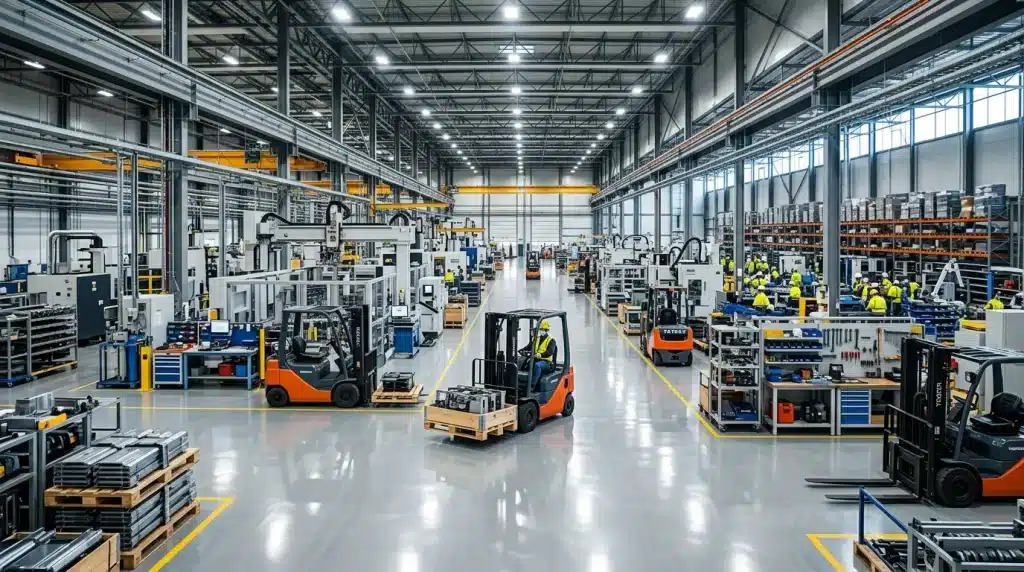
Industrial floors are constantly exposed to mechanical stress, moisture, chemicals, and temperature variations. When the floor coating cannot handle these stresses, failures begin to appear.

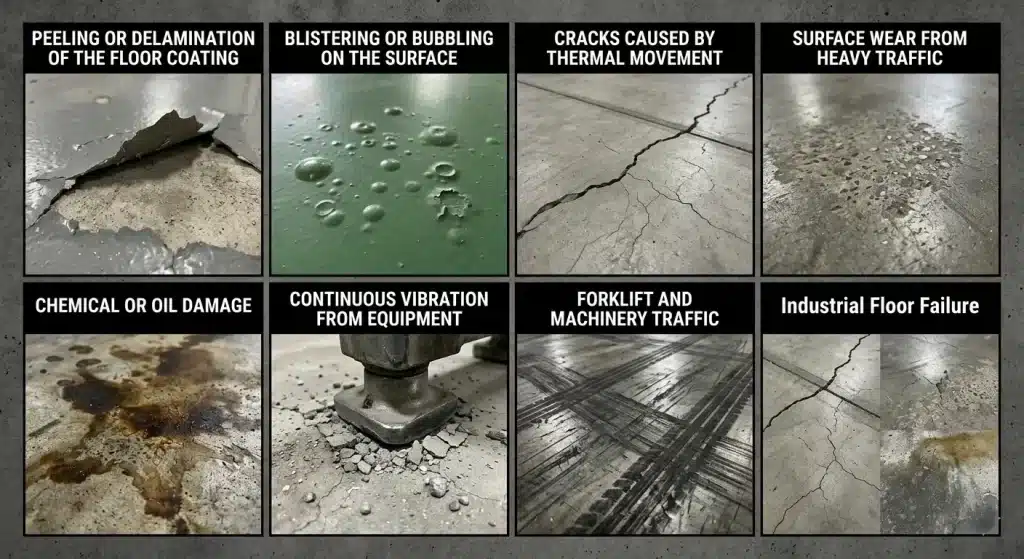
Common causes of industrial floor failure include:

  • Peeling or delamination of the floor coating
  • Blistering or bubbling on the surface
  • Cracks caused by thermal movement
  • Surface wear from heavy traffic
  • Chemical or oil damage
  • Continuous vibration from equipment
  • Forklift and machinery traffic

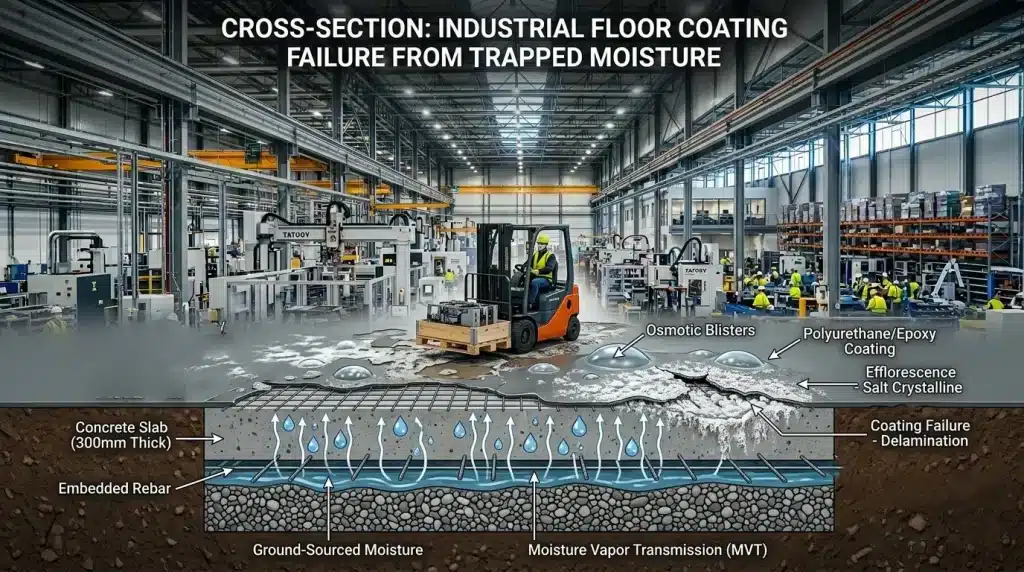
One of the biggest causes of failure is moisture trapped inside the concrete slab. When water vapor rises through the slab, it creates pressure under the coating layer, eventually leading to blistering, adhesion failure, or complete delamination.

Traditional rigid coatings often struggle in such conditions. A more flexible and resilient system like polyurethane floor coating is required to maintain long-term performance.

The Hidden Enemy: Moisture in Concrete

Concrete may appear dry on the surface, but internally it often contains trapped water vapor. Over time, this moisture migrates upward through the slab.

When a coating is installed on top of a moisture-rich slab, several problems can occur:

  • Blistering or bubbling
  • Adhesion failure
  • Efflorescence (white salt deposits)
  • Coating delamination

This happens because moisture creates osmotic pressure beneath the coating, pushing the flooring system away from the substrate.

Modern PU floor coating systems are designed to perform better in conditions where moisture and temperature changes are common.

Key advantages include:

  • Higher tolerance to moisture in the substrate
  • Seamless surface that prevents water penetration
  • Resistance to thermal shock and washdown cycles
  • Reduced risk of cracking or peeling

Because of these properties, polyurethane floor coating has become a preferred industrial floor coating solution in facilities where hygiene, durability, and long service life are essential.

The Science Behind Flexibility in PU Flooring

What makes polyurethane flooring systems different from conventional coatings is their elastic polymer structure.

During curing, polyurethane forms a cross-linked molecular network created by the reaction of polyols and isocyanates. This structure provides a unique combination of:

  • Flexibility
  • Impact resistance
  • Chemical resistance
  • Abrasion resistance

Unlike rigid coatings, PU floor coating can absorb stress and movement without cracking.

Why flexibility matters in industrial flooring

Industrial concrete slabs expand and contract due to:

  • Temperature changes
  • Machinery vibration
  • Heavy load movement
  • Structural shifts in buildings

Rigid coatings cannot accommodate these movements. As a result, micro-cracks appear, which eventually lead to coating failure.

Polyurethane flooring, however, moves with the substrate rather than resisting it, reducing the chances of cracking and peeling.

Application Thickness and System Types

These heavy-duty flooring systems are available in different thickness ranges depending on the application:

System TypeTypical ThicknessApplication
PU Coating0.5 – 1 mmLight traffic areas
PU Self-Levelling2 – 4 mmCommercial spaces
PU Screed4 – 9 mmHeavy industrial environments

The thicker screed systems provide higher load-bearing capacity and better impact resistance.

This is why polyurethane industrial floor coating systems are widely used in:

Polyurethane flooring
  • Food processing plants
  • Pharmaceutical manufacturing units
  • Chemical processing facilities
  • Warehouses and logistics hubs
  • Cold storage facilities
  • Automotive workshops
  • Commercial parking structures

Its high abrasion resistance and flexibility allow the flooring system to withstand heavy machinery and continuous traffic without rapid wear.

A successful flooring system must therefore provide:

  • Flexibility to handle structural movement
  • Abrasion resistance to withstand traffic and machinery
  • Moisture tolerance to prevent blistering and delamination

Why Choose Floorkrete for Polyurethane Flooring

Selecting the right flooring system is only half the solution. The quality of materials and installation expertise also determine how well the floor performs over time.

Floorkrete offers a specialized range of polyurethane flooring systems designed for demanding industrial environments under its Floorthane® series

Floorthane® PU Flooring Systems

FloorThane PU100 – 3-component polyurethane flooring system (2–4 mm) designed for critical industrial environments requiring chemical resistance and durability.

FloorThane PU200 – 2-component self-leveling polyurethane system (0.5–2 mm) ideal for smooth, seamless floors in industrial and commercial applications.

FloorThane PU300 – 100% solids, 2-component pigmented PU coating that provides a hard-wearing, high-quality floor finish for industrial and commercial spaces.

FloorThane PU400 – 3-component heavy-duty polyurethane flooring system (2–6 mm) offering enhanced durability for high-load industrial floors.

Floorthane 5503 / Floorthane 5506 / Floorthane 5501 – Polyurethane-based floor toppings and self-smoothing systems designed for abrasion resistance & chemical protection

Floorthane polyurethane flooring range is engineered to provide:

  • High-performance PU floor coating systems
  • Excellent resistance to abrasion, chemicals, and moisture
  • Seamless and hygienic surfaces suitable for industrial facilities
  • Advanced solutions like PU ESD flooring systems for sensitive environments

FAQ:

Polyurethane flooring is a resin-based industrial floor coating system that forms a seamless, durable, and flexible surface designed for heavy-duty environments.

Both systems have advantages. However, polyurethane flooring offers greater flexibility and thermal resistance, making it suitable for environments with temperature changes or mechanical stress.

A well-installed polyurethane flooring system can last 10–20 years, depending on traffic conditions and maintenance.

Yes. Polyurethane flooring is widely used as an industrial floor coating because it provides durability, chemical resistance, and long-term performance.

Yes. Polyurethane flooring systems are designed to tolerate moisture better than many traditional coatings, reducing the risk of blistering and delamination.

Yes. Its abrasion resistance and flexibility allow it to handle forklifts, pallet trucks, and heavy equipment.

Facebook
Twitter
LinkedIn
anti corrosion coating

RustoBlock S: A Versatile Anti-Corrosion Coating for Metal & Concrete

RustoBlock S: A Versatile Anti-Corrosion Coating for Metal & Concrete Despite various developments in technology over the past few years, corrosion continues to pose significant problems for the construction industry. From roofing sheets, steel structures, pipelines, or concrete, exposure to moisture, oxygen, and other chemicals causes deterioration of materials over

Read More »