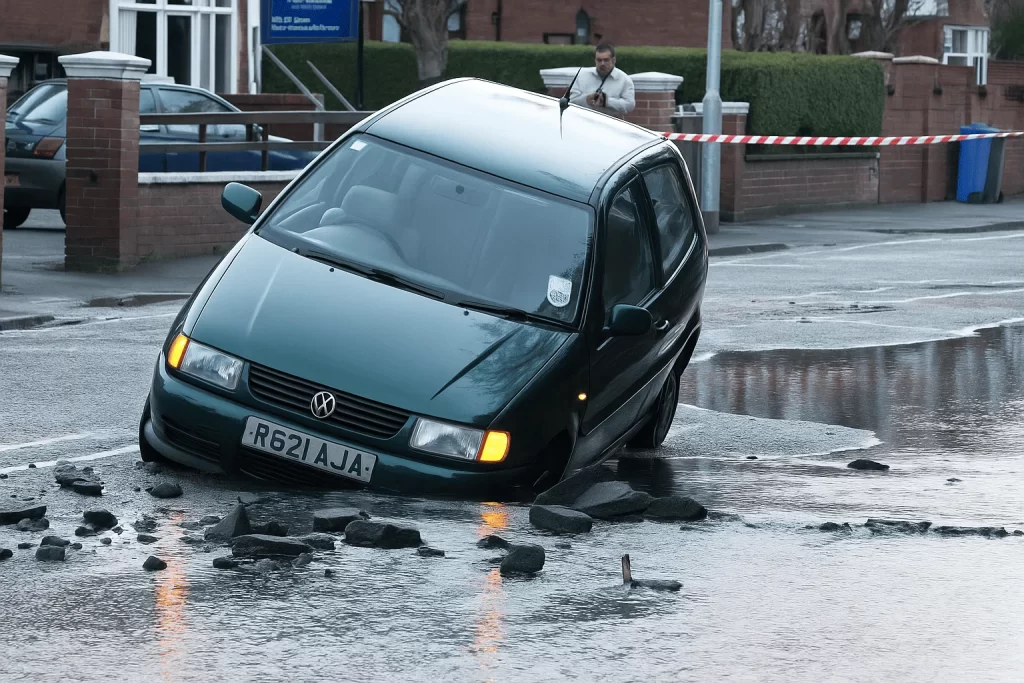
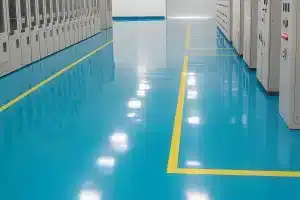
With its large land mass and high population, India is heavily reliant on its road network. Whatever the asset – urban, regional, freeway, highway, tollway – or the operator – state or local government or private – the maintenance requirements of a road network are complex, extensive and ongoing.
MULTICHEM works with clients to develop and provide specific road maintenance and highway repair products and services, tailored to individual road networks and their operating environments. We complement these with a comprehensive road maintenance management system, which applies a streamlined, online asset management approach to individual road maintenance contracts.
Our strong track record in the road maintenance and highway repair products sector is enhanced by our philosophy of empowering at the local level. This creates an environment where our people, who use the road on a daily basis, make decisions on a ‘best for community’ basis.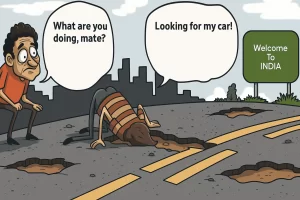
Responsibility
While adoption of competitive bidding for road and other civil works has been the norm in most countries of the world, some countries do not have a sufficient industry of independent contractors and road works are mostly done by force account or awarded to state construction agencies on a negotiated basis. In many of these countries, not only are costs high and quality low, it is common for suppliers of construction materials and services to have monopoly power, further increasing inefficiency and lowering quality.
In these situations, it is a combination of transferring work from the public to private sector and the introduction of competition into operations that is often the best way to decrease inefficiency and improve quality. Introducing competitive highway repair into public works contracts is also often an important first step to this goal.
End Effect of Bad Roads – Road Accident
According to the report Road Accidents in India, 2011, by the Ministry of Road Transport and Highways, a total of 1,42,485 people had lost their lives due to road accidents. Of these, nearly 1.5 percent or nearly 2,200 fatalities were due to poor condition of roads as per records.
The figures have been steadily growing by 10 to 15 percent in the past decade. In India during monsoon, the number of accidents spikes up multiple times as the condition of roads deteriorates further. However, the official numbers hardly reveal the gravity of the situation. Experts believe the actual number of deaths due to bad roads is much higher at around 10,000 per year as most accidents do not get reported. There is hardly any accountability.
For bad roads in India, there is no one to monitor the real cause behind the accidents in such cases. The police generally put the blame on negligence on part of drivers, even when the real cause behind the accident is bad roads,” says Harman Singh Sidhu from ArriveSafe, an NGO that works towards road safety.
Figuring out who is liable for most car accidents isn’t a mystery. If you are stopped at a stop sign, and the car behind you rear-ends you, then that driver is most likely liable for damage to your vehicle and for any injuries you suffer. But what if your vehicle is damaged (or you are injured) because of: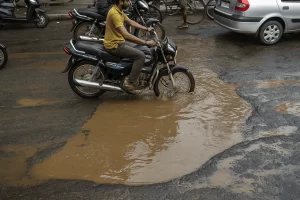
• Potholes,
• Shoulder drop-off
• Oil and chip
• Construction zone
• Icy or snowy roads, or
• Wet roads.
Who is legally liable in those situations? In many cases, it is the government entity charged with maintaining the road where your accident took place. But there are also times when someone other than the government is responsible. In this article, we’ll help you determine who is responsible if your vehicle is damaged due to poor road conditions, and how to proceed with making a claim.
Fuel Consumption
Amidst the raging politics on petroleum pricing, a report has established that the country was losing ₹87,500 crore because of poor roads and tolling systems annually.
The figure gains significance against the backdrop of desperate attempts by the Union government to curb the subsidy outgo on petroleum products that puts a drain of approximately ₹1.38 lakh crore on the exchequer.
Going by the report, prepared by IIM-Calcutta on behalf of Transport Corporation of India, the stated loss of ₹60,000 crore accounts for almost 43 percent of the drain the government is said to suffer due to growing consumption of diesel, petrol, CNG and LPG.
As a matter of fact, the loss due to defective road systems is more than the under-recoveries on diesel, reported by the Petroleum Ministry, which was ₹81,192 crore in 2011-12, though it was estimated to ₹1.07 lakh crore in 2012-13.
According to the report on operational efficiency of freight transportation by road in India, no appreciable difference was noted in terms of average speed of vehicles, mileage, stoppage delays per km and stoppage expenses per ton-km between 2008-09 and 2011-12. The report estimated that stoppage delays cost the economy approximately ₹27,500 crore per annum, and the impact of additional fuel consumption due to stoppage delays and slow speed of vehicles was around ₹60,000 crore.
These figures are highly underestimated. During rainy season because of bad roads, travel time gets doubled or even triples the time otherwise required with normal speed in other summer or winter seasons. This in turn means loss of man-hours, loss of fuel, loss of money for vehicle maintenance, and loss on durability of vehicle itself. If we calculate all above losses in terms of money, it may go into lakhs of crores of rupees, which is direct loss to our country’s asset. The report called for immediate development of new roads, and widening and maintenance of the existing roads, besides shifting to electronic toll collection system, as the present one delayed each freight vehicle by approximately five to ten minutes.
It also called for access-controlled expressways, and suggested that at least 18,637 km of expressway be built in the 13th Five-Year Plan. At present, India has just 600 to 700 km of access-controlled expressway, as against 74,000 km in China.
Economic Loss
Poor infrastructure has been eating into India’s annual economic growth, which slowed to 6.7% in 2008/09 after three years at 9%. Infrastructure limitations are India’s most serious constraint to growth as they slow down poverty reduction measures.
According to an April 2011 World Bank report entitled Curbing Fraud, Corruption and Collusion in the Road Sector, 163 people are lifted out of poverty for every million rupees spent on developing roads in rural areas. But as Robert Zoellick, president of the World Bank (2007-2012), said in a statement released with the report, although building an extensive network of roads can help boost a nation’s economic growth, corruption and collusion often delay the efforts:
“Corruption in the roads sector is a problem for both developed and developing countries, yet the economic and social loss is more profound for poor communities in developing countries.”
However, the estimated cost of road crashes as a percentage of GNP in most African countries ranges from about 0.8% in Ethiopia and 1% in South Africa to 2.3% in Zambia and 2.7% in Botswana to almost 5% in Kenya and Malawi. Furthermore, the economic cost of road crashes in Africa is expected to increase by 80% over the next seven years according to projections by the WHO.
Repair of Bad Roads – General Methods of Repair
• Potholes Repairs
• Surface Dressing
• Micro Asphalt Surfacing
• High Friction Surfacing
• Conventional Surfacing
Potholes Repair
TYPE 1 – for potholes where a sound edge can be achieved.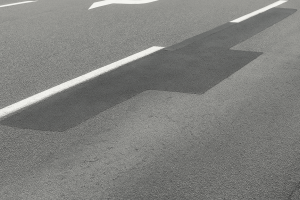
• Place out traffic management as required
• Each pothole to be cut back to a sound edge using disc cutter or breaker pack
• Supplied with roller or equivalent where practicable
• Remove all loose material and sweep pothole clean
• Apply tack coat to the base and sides of the pothole
• Place 10mm hot surface course and compact with roller or Wacker plate
• Over band all vertical joints with approved product
• Remove all waste from site and dispose of at bona fide tip
• Remove traffic management
TYPE 2 – for potholes where the surrounding area is in a poor state and breaking back to a sound edge cannot be achieved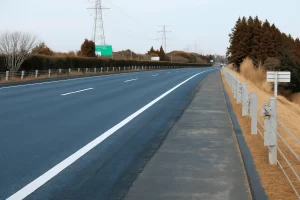
• Place out traffic management as required
• Remove all loose material and sweep hole
• Apply tack coat to the base and sides of the pothole
• Place 6mm hot surface course and compact using roller or Wacker plate
• Remove all waste from site and dispose of at bona fide tip
• Remove traffic management
Surface Dressing
Surface dressing is the application of hot bitumen and chippings to the road surface. It is one of the most cost-effective methods of highway maintenance available and is very widely used, but is not usually suitable for high-stress sites e.g., roundabouts.
Surface dressing seals the road to prevent the ingress of water and the bitumen forms a protective barrier against rain and frost to protect the road foundations, significantly extending the life of the road. Surface dressing also restores skid resistance leading to increased safety as well as enhancing the appearance of the road.
Once the bitumen and chippings have been laid, a heavy roller provides an initial degree of embedment but the real work of consolidation is provided by the traffic. Shortly after application and rolling, the road is swept and markings applied, usually within 2 to 4 working days.
Surface dressing has a limited life of between seven to fifteen years depending on traffic and environmental factors.
Micro Asphalt Surfacing
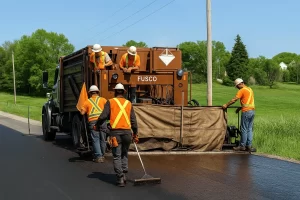
Slurry seal is a relatively cheap material consisting of a bitumen emulsion and aggregate slurry, which is laid cold by a paving machine following the existing shape of the road or footway surface. It seals the surface and improves skid resistance and has very good stress-absorbing characteristics. It will normally last between 5 and 10 years.
Micro-asphalt surfacing is a multi-layer version of slurry seal and can restore a desirable profile, improving ride quality. It is typically undertaken on busy urban thoroughfares, housing estates, roundabouts and motorway hard shoulders. The finished surface has low noise characteristics and good riding qualities. It is an efficient process that allows us to reduce time spent on-site and minimize disruption.
High Friction Surfacing
When the road surface is wet,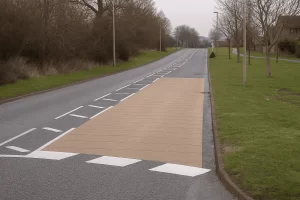 skidding resistance is lowered and accident potential increases. While traffic levels have risen over recent decades, the use of high friction surfacing at crossings, road junctions and other potential danger points has contributed to an overall reduction in the number of pedestrian accidents.
The term high friction surfacing covers a range of material types with differing costs, effectiveness and durability.
Conventional Surfacing
Resurfacing is designed to restore the surface profile of a road, usually for rideability and drainage purposes and to provide improved texture and skid resistance. The resurfacing usually takes the form of inlay or overlay.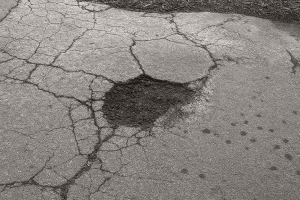
Inlay is where the old surface is planed off and replaced by a new one. This can also involve the base layers to give additional strength.
This is normally done where the existing surface has failed badly and could not support a new surface or where restraints such as kerb levels, accesses etc. prevent the road level being raised. Inlay is most common in urban situations.
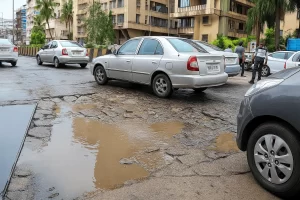
Overlay consists of adding material on top of the existing road to improve the profile and add strength and is more common in rural situations. As well as overlaying the surface, localized reconstruction may be required before the road is overlaid. The most common material currently used is stone mastic asphalt (SMA) along with bitumen macadam and hot rolled asphalt. The laid thickness is normally between 25–50 mm.
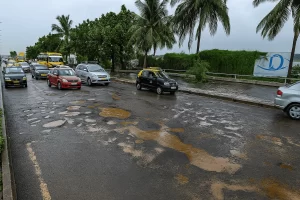 Retread (Carriageway Reconstruction)
Where the carriageway pavement or footway is beyond repair then conventional or retread reconstruction is necessary.
‘Retread’ is an in-situ recycling process and is more ‘environmentally friendly’ than some other treatments. It involves treating the top 75 mm of the existing road, milling down the existing surface and adding bitumen and aggregate (if necessary). The surface material is then regraded and rolled to form a revitalized pavement. The surface is finally sealed with a surface treatment as part of the process.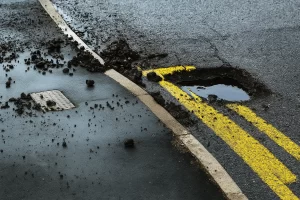
Pavement failure may be attributed to any one or a combination of the following:
• Sub-grade softening due to poor drainage.
• Sub-grade softening due to ingress of moisture through cracked and pervious pavement layers as a result of progressive oxidization.
• Sub-grade failure due to insufficient pavement thickness.
• Frost heave
Modern Products and Methods of Repair
Multichem has developed 4 products/systems to repair damaged roads without affecting vehicle transport.
- UltraPatch: Asphalt-based concrete to patch up potholes, sets in 2 hours
- UltraFill: Special cement, with setting time 3 mins to 30 minutes
- HiperCrete: Special cement-based repair product with setting time 3 mins to 2 hours
- RhinoShield: Special asphalt road sealer to increase the life of road
UltraPatch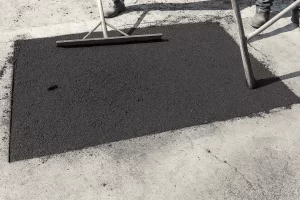 UltraPatch is a cold-applied ready-to-use asphalt-based pothole repair material. It can be used by municipalities, contractors and business owners to fill potholes and repair roads. Cold patch asphalt is a preferred method for patching potholes today because it is easy to use and does not require any heavy machinery. In fact, you need only a shovel and a tamping tool. Another benefit of our UltraPatch is that it can be used year-round on highways, roads, driveways, and more. Winter, Spring, Summer, Fall — UltraPatch keeps on working and stays workable!
It has the following properties:
• It can be used in wet or dry weather conditions. Very much suitable in rainy season.
• The material sets in 1 to 2 hours, hence restores to original surface instantly.
• Technically superior hence unmatched performance with each pour.
• Used under any extreme weather conditions.
• Comes in easy-to-carry, 25 kg bag.
• Shelf life more than 12 months.
UltraFill
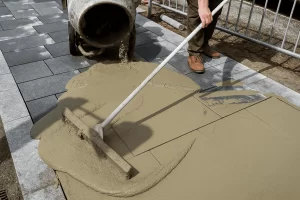 UltraFill is made of special cementitious materials with proprietary additives to give fast setting properties. The product is popularly used for repairing or patching cracks, holes and spalled areas of highways, airfield pavements, bridge decks, as well as a variety of commercial and industrial applications.
Special Properties:
• Setting Times: 2–10 minutes
• Compressive Strength: 3000 psi (20 N/mm²)
UltraCrete
UltraCrete is manufactured from cementitious products with proprietary additives to give very high strength and fast setting time. It comes in different categories to be used as per requirement of site conditions.
RhinoShield
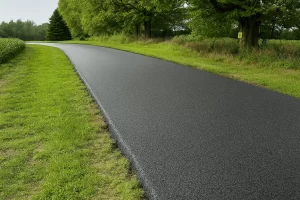
RhinoShield is a proven sustainable maintenance product for roads and highways, runways etc. Treatment of RhinoShield will increase the life of asphalt roads and highways by more 5–7 years of normal life. Product comes in 25-litre drum and can be sprayed or brush applied.
For further details contact:
Multichem Industries Pvt. Ltd.
Phone No: +91 9619091025
E-mail: info@multichemgroup.net
Web: www.multichemgroup.net