The Multichem Group AntiCarbonation coatings are designed to extend the service life of steel reinforced concrete by restricting the damaging passage of carbon dioxide. Left unchecked, the infusion of carbon dioxide from atmospheric pollutants pacifies the alkaline nature of concrete leaving embedded rebar susceptible to corrosion and ultimately concrete spalling where the expansion from within due to the corrosion by-products literally blows the concrete apart.
Why Anti Carbonation?
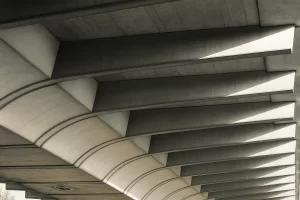
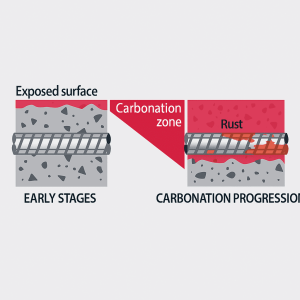 Concrete structures deteriorate with time and deterioration is much faster in extreme environment associated with high humidity, chlorides and CO₂ in the atmosphere. Ingress of moisture and deleterious substances such as chloride ions, CO₂ and other chemicals take place through the pores of the concrete by the process of diffusion and initiates the corrosion of reinforcement and subsequently damaging the RCC (Reinforced Concrete) structures. Protection of RCC structures by a suitable protective coating is a well-accepted method for increasing the service life in such extreme environment. Without a protective coating the degradation of RCC structures becomes very fast for corrosion of embedded steel reinforcement. Infrastructure projects such as bridges, flyovers, and underpass and parking garages are prone to ingress of CO₂. A dense compacted concrete with mineral and chemical admixtures with a low water cement ratio alone cannot prevent such corrosion. Hence additional protection measures such as protective coating, corrosion inhibitors of calcium nitrite based for new structures and migrating corrosion inhibitor for old structures, and corrosion resistant steel or anti-corrosive painting of steel is quite often essential for increasing the durability and service life. The latest technology of cathodic protection is also more suitable for additional protection for structures such as bridges and flyovers.
Mechanisms of Concrete Deterioration : Chloride-Induced Corrosion
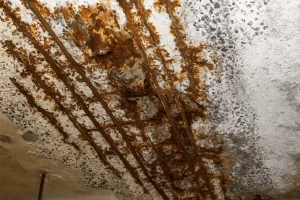
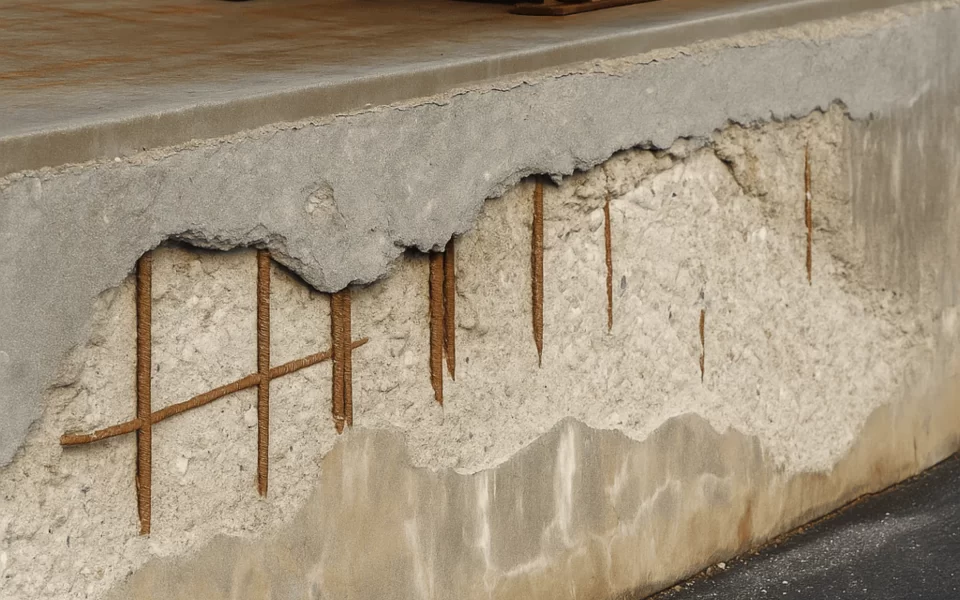
Steel bars used as reinforcement in concrete (‘rebars’) are covered by a thin passive layer of oxide that protects them from oxygen and water, which may cause corrosion and produce rust, as shown in Figure. This passive layer can only be maintained at high pH values (i.e. pH > 12 or at a chloride ion content less than a corrosion threshold). When chloride ions penetrate the concrete and then accumulate to a critical level on the surface of steel reinforcement, the protective layer is destroyed, a process known as De-passivation.
Carbonation
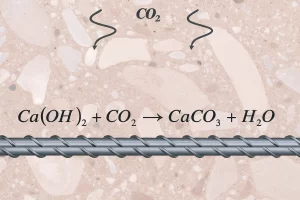 Carbonation in concrete is caused essentially by the penetration of atmospheric CO₂ especially at a relative humidity of between 50 and 70 percent. The carbonation process is initiated when the pH of concrete drops below a critical value. Unchecked, it will eventually cause corrosion and cracking followed by spalling, as shown in Figures 1 and 2. Carbon dioxide reacts with CH and CSH producing calcium carbonate. The process reduces the pH of concrete and destroys the passive layer.
Properties of Anti Carbonation Coating: Multicoat-Carbonil Provides resistance to weathering
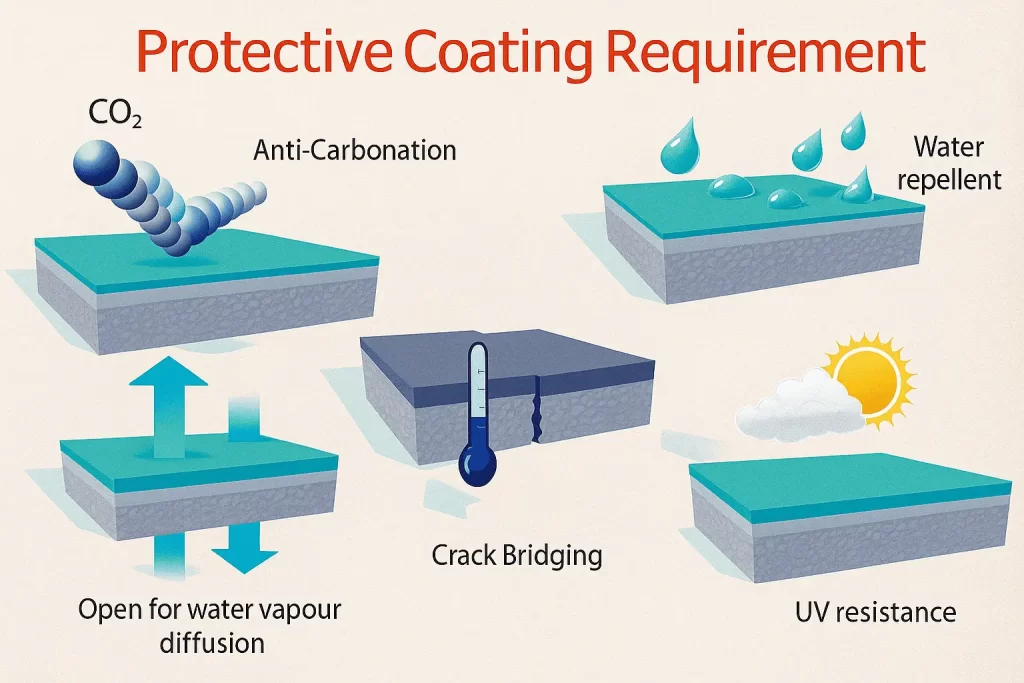
The coating has excellent adhesion to the substrate and cures to form a flexible film that allows the surface to breathe and acts as carbon dioxide barrier thus protecting the concrete in aggressive weather conditions. It is that properties which enable the water vapor to move in and more importantly out of the concrete with the fluctuation of temperature and humidity. The water in concrete tends to go from wetter to drier section. Breathability is essential because, moisture movement in concrete may lead to osmotic pressure building up under non-breathable coating and eventual debonding of the protective coating. Breathability also enhances drying of the internal concrete, arresting corrosion. Mineral based coating or high-performance acrylic polymer modified anti-carbonation elastomeric coating, provide much higher breathing capacity than most resin-based coating, and thus can protect structures longer.
Excellent carbonation barrier
The microporous structure of coating acts as barrier to the entrance of carbon dioxide, chloride and other acid gases, at the same time allowing the passage to water vapor from the substrate thus allowing the substrate to breathe.
Waterproofing properties
Multicoat™-Carbonil allows the walls to breathe still remaining waterproof. This coating allows water vapor to transfer from inside the concrete to outside without any crack or failure in the coating. At the same time, it does not allow liquid water to penetrate the concrete structure.
Crack bridging properties
This is the important property as the coating should be able to negotiate expansion and contraction in the structure due to temperature or dynamic load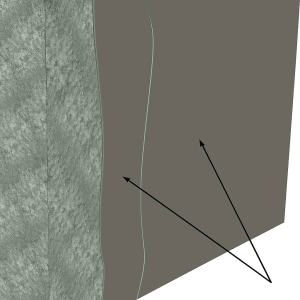 . It should also effectively seal and bridge over crack, to ensure no water or gases enter concrete through them. Even after extensive weathering, protective coating should provide excellent bridging capacities in variety of static or dynamic loading condition, in varying exposure condition and even on weathered concrete surfaces. The elastomeric nature of this coating ensures good crack bridging properties, in case of structural movement.
Excellent bonding and long lasting
Excellent bonding of this coating to the surface ensures long lasting adhesion. A bright, clean, transformed exterior always adds value and durability to the structure.
Flexible & durable
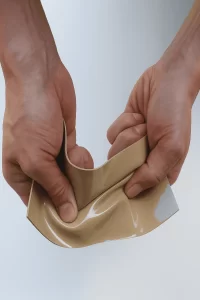
Unlike paint, Multicoat™-Carbonil is flexible so there is no cracking, flaking or peeling. Due to its excellent flexibility it gives high durability.
Ultraviolet (UV) ray’s resistance
For exterior application it is mandatory that the coating should be UV stable. The effect of sunlight can cause certain polymers to become brittle and change their physical and chemical properties. Exposure to sunlight also leads to fading of pigment and differential coloring marring the beauty of structures. Correctly designed protective coatings remain flexible even after exposure to sunlight without degrading.
Summary
Anti carbonation coating such as Multicoat™-Carbonil is used to protect structure from attack from carbon dioxide, water leakage and other damaging gases. Being based on pure acrylic resins, Multicoat Carbonil is resistant to UV exposure, has crack bridging properties and highly durable to give long term protection to structure.
For further details contact:
Multichem Industries Pvt. Ltd.
Phone No: +91 9619091025
E-mail: info@multichemgroup.net
Web: www.multichemgroup.net