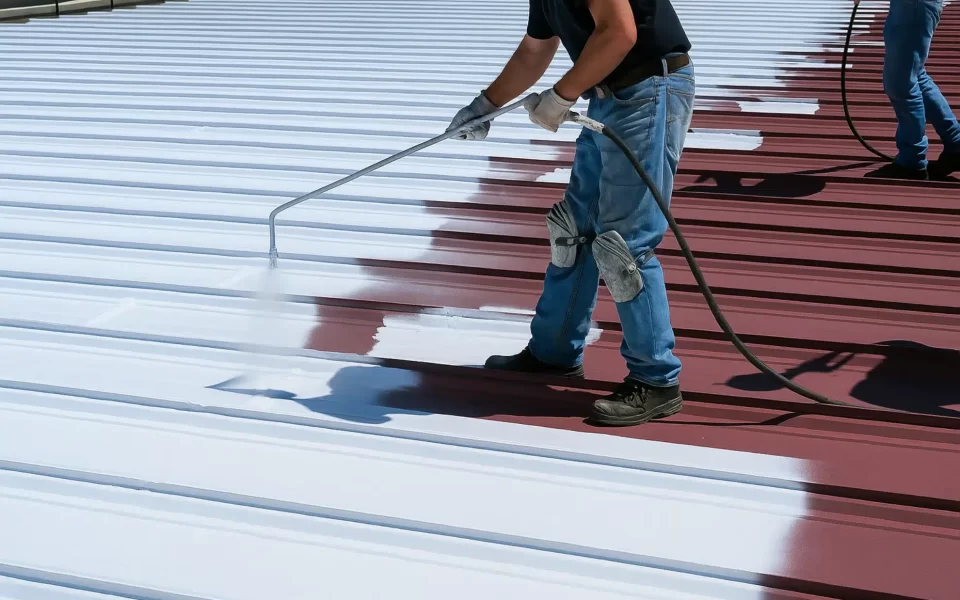
Roofing Technology has evolved dramatically over the past 25 years, offering a wide range of advanced options for builders, property owners, facility managers, and design professionals around the world. India, too, has experienced a surge in adoption of modern roofing systems, particularly in the last five years. The process of coating a roof is now more sophisticated, requiring proper understanding to ensure maximum return on investment. With advancements in formulations and application techniques, roofing has become a multi-faceted subject. To meet today’s demands, it is essential to use high-performance roofing products that ensure occupant comfort, long-term durability, and energy efficiency. Equally important is the contractor’s responsibility to follow application guidelines meticulously. The success of both new installations and restoration projects depends heavily on selecting the right coating chemistry and executing the process correctly.
Why Roof Coating?
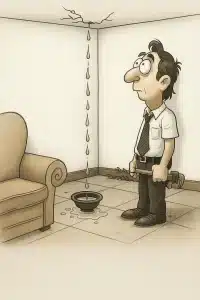
Keeping your roofs and maintaining in good condition is very important. It is your property’s main defense against the elements (e.g., leakage, heat, etc.) and a very critical part of its overall structure value. Neglecting your roof will cause damp conditions that will quickly bring about decay and expensive structural damage. It is always better to be safe than sorry!
Coating Chemistry
Today, a variety of materials are used in roofing and in preparing the surface to which a coating is applied. Along with asphalt BUR and modified bitumen surfaces, the range of materials includes EPDM and Hypalon thermoset membranes, PVC and TPO thermoplastic membranes; SPF (spray polyurethane foam), and metal surfaces finished with a wide array of factory-applied paints or coatings.
Acrylic coatings are typically water-based, easy to handle, moderately priced, and exhibit good performance in a wide variety of applications to nearly every one of the roof substrates described here. For those reasons, acrylics are the most commonly used highly reflective roof coatings. Acrylic coatings cure by water evaporation, exhibit a reasonable degree of cohesive strength (moderate elongation and tensile strength), and will provide good adhesion to most roof surfaces. Because acrylic coatings are water-based, performance and application limitations do come into play. Ambient weather conditions during application are very important. Multichem offers Roofshield® Basecoat and Topcoat in pure acrylic version.
Polyurethane roof coatings are solvent-based and offer superior physical properties—such as higher elongation, tensile strength, and adhesion—compared to acrylic coatings. Though more expensive, they’re ideal for high-stress roof areas like fasteners, seams, and penetrations, especially on metal roofs. Available in high-solids, single-component moisture-cure (e.g., Roofshield® Finish-Coat) or two-component reactive types (e.g., Roofshield® Smartcoat), they comply with VOC regulations. These coatings provide excellent water resistance, perform well across a wide temperature range, and are less sensitive to weather during application, though they are more challenging to apply due to their solvent content.
Silicone coatings are solvent-based and are typically used in the coating of SPF roof surfaces. Silicone coatings weather very well and offer good adhesion to SPF, but are characterized by fairly weak cohesive strength, lower tensile strength, and modest elongation. They exhibit good resistance to water, but possess limited abrasion resistance. Their use is essential in recoating of existing silicone-coated SPF roof surfaces. Roofshield® Premiumcoat is one such product manufactured by Multichem.
In this article, we will be focusing more on Acrylic Elastomeric roofing and wall coatings.
Minimum Performance Requirements For Liquid Applied Roof Coatings
Physical Property ASTM Test Procedure Requirement:
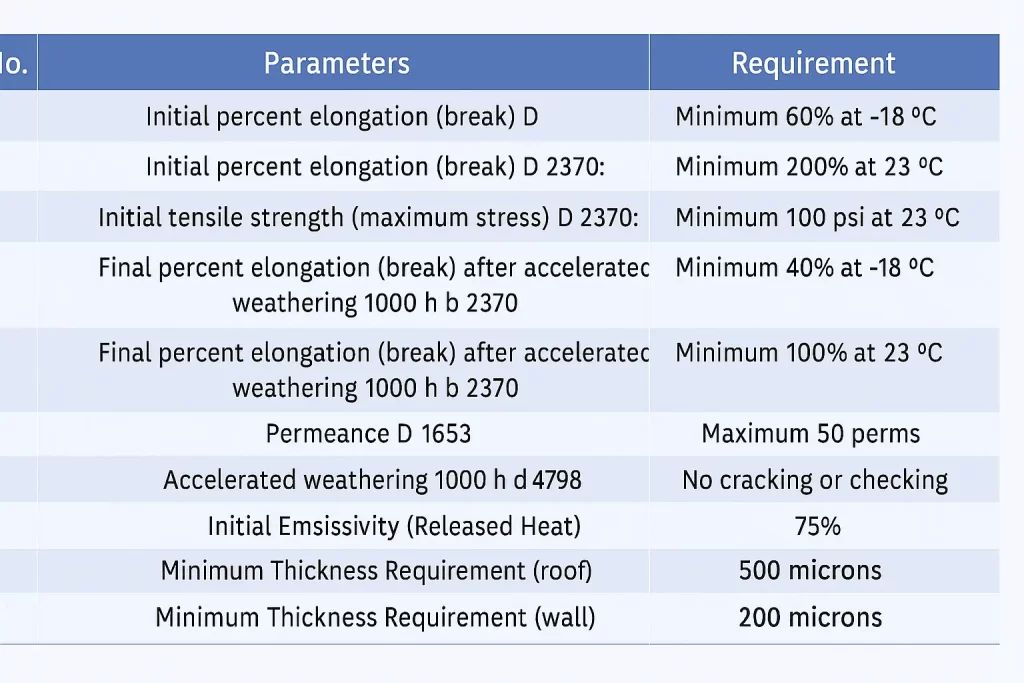
Acrylic Roof Coating & Requirement
Acrylic polymers are engineered and are specifically designed for roof applications, and specifically for roof coatings. Coatings manufacturers have tried to use house paints on roofs but these were too brittle. Formulators also tried to use caulk and sealant technology to make elastomeric roof coatings, but they have not been totally successful—resulting in failures. Today the technical requirements for a successful roof coating are fully understood.
Acrylic elastomeric roof coatings refer to a liquid-applied monolithic (seamless), fully adhered, elastomeric membrane that’s formed in situ on the roof. These coatings are applied 5 to 10 times thicker than house paint. Typically, the thickness of exterior house paint is 70 microns. For elastomeric roofing applications, these would be 500 microns to 1000 microns. So, we’re talking about membrane-like materials. EPDM is often 1000 microns; Hypalon® and PVC are 1.5 mm. However, with these coatings the membrane comes out of a can. That’s why the term formed in-situ on the roof is used. It’s applied as a liquid. As it dries, it forms a tough membrane, like EPDM and like Hypalon®.
But, unlike those materials, it has no seams. No field or factory seaming is necessary. Moreover, it is also fully adhered. These coatings are not mechanically attached like other types of single-ply membranes.
Expansion and Contraction
Roofs are dynamic environments, meaning they expand and contract. We look at a building, and we don’t think it moves. In a microscopic examination, roofs are dynamic. There’s thermal expansion, seismic expansion, the weight of snow and rain loads, wind uplift and “flutter” and vibrational effects that subject roofs to movement. The coating must be able to tolerate all kinds of movement at room temperature, and high temperature in the summer, low temperature in the winter. Roofs must also tolerate foot traffic resistance. People are going to be walking on these roofs for servicing HVAC units, cooling towers, satellite dish antennas; all kinds of equipment that’s placed on a roof. The roof must be able to withstand foot traffic and the abuse from maintenance and repair crews.
However, these Elastomeric are not caulks or sealants. While they must tolerate expansion and contraction, and the dynamics associated with the roof, just like a caulk or sealant. But, caulks and sealants don’t require resistance to standing water, impact resistance, or reflectivity properties, they simply become part of complete roof/wall protection system.
Durability
The key property required of any roof coating material is durability. Acrylic technology is widely used in exterior applications for sealants, industrial coatings, house paints, because of its durability. Durability implies resistance to the effects of UV degradation from the sun. The sunlight strikes a polymer, such as asphalt, the asphalt absorbs some of the radiation, and the polymer begins to vibrate, and break up into smaller pieces. This is the degradation that is associated with the harmful effects of sunlight. This can be seen readily in aged asphalt roofing. When new, it looks good. However, over a period of six months, there’s a brown chalky residue. This is the result of ultraviolet degradation from the sun.
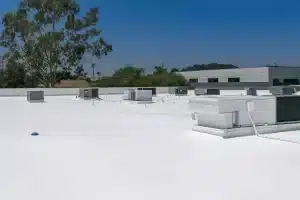
Acrylic polymers are transparent to ultraviolet radiation which means they do not absorb the sun’s destructive radiation. The polymer is not absorbing any of the radiation; it’s reflecting the radiation back into the atmosphere. When that same acrylic polymer is formulated into a roof coating and the UV transmission is measured, there is no transmission. The coating contains UV blocking pigments that reflect this degrading UV radiation and so the roof substrate is protected.
Adhesion
By definition, the coating is a “fully adhered, single-ply membrane formed in situ on the existing roof.” For the coating to function properly, it must remain adhered. Many chemical and interface science principles are involved in the study of adhesion. But simply stated, adhesion is an interfacial property, i.e., the quality of adhesion is dependent upon the composition of each of the materials being joined. Applying an epoxy adhesive to a silicone release paper will not provide a satisfactory bond. However, the glue is not deficient. Thus, the quality of adhesion of a roof coating is a function of the coating and the membrane, the coating substrate. Proper surface cleaning prior to coating application can dramatically reduce or eliminate adhesion-related problems.
Water Resistance
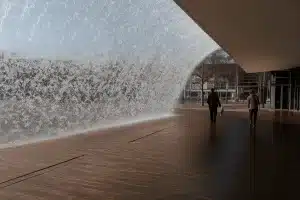
While adhesion and tolerance for dynamic movement are critical for a successful roof coating, the need for water resistance is another requisite in India. If the elastomeric coating expectations include stopping leaks that might develop during the weathering period, the coating must have sufficiently low permeance to act as a waterproofing membrane in the same fashion as the existing roof. If the coating requirements are to protect the existing roof membrane, then low permeance is not a performance requirement.
However, whether or not the coating provides actual water resistance, it is also important for it to exhibit low swelling characteristics. Swelling is defined as the percent weight or volume gain after immersion into a solvent (water). If the coating exhibits high swelling values, the volume increase will produce unwanted stress on the coating-to-substrate interface. This can result in coating delamination.
While the above paragraphs may have created some confusion regarding how to identify a “quality coating,” this can be greatly simplified by employing ASTM D-6083, “Standard Specification for Liquid-Applied Acrylic Coating Used in Roofing.” This specification, first introduced in 1997 and reapproved in 2005, outlines specific tests and minimum values for mechanical properties (tensile strength and elongation), adhesion, permeance, water swelling, mildew resistance, and in-can physical properties.
Important Consideration
The following are a few things to keep in mind when considering roof coatings:
- Exterior durability. How well does it weather? Acrylic roof coatings offer excellent durability, UV resistance, and substrate protection from degradation from sunlight.
- Low temperature flexibility. How flexible is the coating at cold temperatures? If the roof is in Delhi, and it’s roughly zero in the winter, the roof and any coating must be able to tolerate movement and not be brittle and crack. If the roof coating product data sheet claims this coating will stretch 300% before it breaks, that’s OK at room temperature. However, what happens at 0°C? Or at 50°C in the summer time? These are key criteria for successful acrylic roof coatings.
- Dirt pickup resistance is another important issue. If the coating is to reflect the sun’s heat, it must be and remain white in color. As it darkens as a result of dirt pickup, the air conditioning energy savings realized will be lessened or lost. This will be discussed later in this paper.
- Adhesion. How well does the coating adhere to the roof substrate? These may include aged metal, aged BUR, aged cap sheet, aged EPDM, PVC, Hypalon®? These are important considerations when selecting among acrylic roof coatings.
- Ponded water resistance. How well does the coating adhere after long-term submersion in puddles on the roof?
Reflectivity and Reduces the Cost
Reflectivity and dirt pickup resistance were mentioned earlier. This is a key property for an elastomeric coating that is growing in importance. Simply put, the whiter it is the cooler it is. Typically, an infrared thermometer is used to measure the surface temperature. Many experiments have been carried out worldwide to measure temperature at different intervals of time, daytime as well as in night.
The results show the benefits of reflectivity as the white elastomeric acrylic coating protects even asphalt roofing material or dark substrate and keeps it cooler.
The black roofing undergoes a lot more stress, a lot more strain, more expansion and contraction, as a result of these temperature fluctuations. The thermal stress will shorten the life of a black roof. Whereas white acrylic roofing remains durable in extreme weathering conditions.
Fire Retardancy
Another benefit of acrylic roof coating is in the area of fire retardancy. Many roofing systems require an Underwriter’s Laboratory Class A rating. A fire test, according to a standard specification UL790. This elastomeric coating can be formulated with fire retardant pigments to reduce the burning effects on the roofing system.
Under UL790 a test called spread of flame is conducted at Underwriters Laboratory. It’s a mockup of a roofing system four feet wide, 12 feet long; there’s a slight incline to the mockup. The mockup consists of a wooden deck with isocyanate board stock insulation and a built-up roof applied over top. This is topped with a white acrylic elastomeric coating containing fire retardant pigments.
A gas flame is turned on at the low end, and the flame propagation is measured after 10 minutes burning. If it goes less than six feet, the roof system (the deck, insulation, membrane and coating) gets a Class A rating. It is important to remember that it is the system and not merely the coating that gets the fire rating.
Cool Roofing
A cool roof is one that has been designed to reflect more sunlight and absorb less heat than a standard roof. Cool roofs can be made of a highly reflective type of paint, a sheet covering, or highly reflective tiles or shingles. Nearly any type of building can benefit from a cool roof, but consider the climate and other factors before deciding to install one.
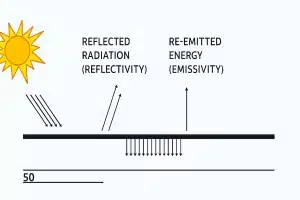
Just as wearing light-colored clothing can help keep you cool on a sunny day; cool roofs use solar-reflective surfaces to maintain lower roof temperatures. Standard or dark roofs can reach temperatures of 65°C or more in the summer sun. A cool roof under the same conditions could stay more than 10°C cool.
There are two things that keep a roof cool:
High reflectivity – High emissivity.
Cool roof coatings reflect 70% to 90% of the sun’s energy when newly installed. Most of the energy is radiated away. Conventional roofing materials have reflectivity of 5% to 25%, meaning they absorb 75% to 95% of the sun’s energy. A typical “white” capsheet roof only reflects 25% of the sun’s energy. The absorbed energy is transferred to the building.
Emissivity is the ability to radiate away absorbed heat. Most cool roof coatings emit 90% or more. Even though aluminum-coated roofs are highly reflective, they are not considered a cool roof because they only emit 50% to 60% of the absorbed energy.
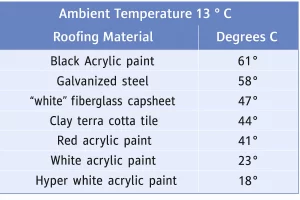
Even at relatively cool temperatures there is a big difference in how much heat is absorbed. The chart on the left, done by Lawrence Berkeley National Laboratory, demonstrates how different roofing materials are affected on a sunny day when the air temperature was only 13°C.
Cooler roof surfaces mean less heat is transferred into the building. If you air condition your building, you will save money on cooling energy. How much you will save depends on many factors including roof insulation, cooling system equipment, and other variables. In the right situation, a reflective roof can bring cooling savings of up to 50%, with a reduction in peak cooling demand of 10% to 15%.
Benefits of Cool Roofs
A cool roof can benefit a building and its occupants by:
- Reducing energy bills by decreasing air conditioning needs
- Improving indoor comfort for spaces that are not air conditioned
- Decreasing roof temperature, which may extend roof service life
Beyond the building itself, cool roofs can also benefit the environment, especially when many buildings in a community have them.
Cool roofs can:
- Reduce local air temperatures (sometimes referred to as the urban heat island effect)
- Lower peak electricity demand, which can help prevent power outages
- Reduce power plant emissions, including carbon dioxide, sulfur dioxide, nitrous oxides, and mercury, by reducing cooling energy use in buildings
Product Systems Offered by Multichem
Products: The range covers different types of substrates and performance requirements.
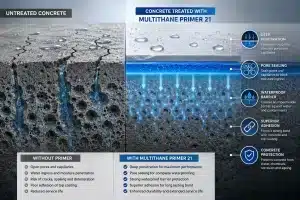
Primers: Required for achieving perfect bonding with substrates.
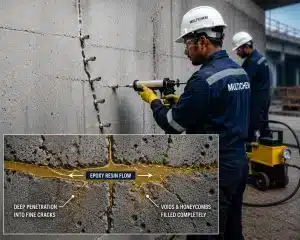
Caulking Compound
Wall Coatings : Walls also need complete protection from weathering conditions.
- Rainshield AC-coat
- Rainshield Superflex (single component PU systems)
- Powercoat XL
- Wallcoat
Conclusion
Acrylic coatings provide extended durability. They can be applied over any type of a roofing system, and they will dramatically enhance the life of that roof. They can be applied initially, to a new roof, and they can be applied somewhere later during the life of the existing roof.
They reduce the energy costs. A white acrylic roof coating applied over a smooth surface built-up roof reduces the energy costs, saves money, and also extends the life of that roof.
They can lower the roof life cycle costs by making the roof last longer, and can extend the date that the roof will be replaced.
From an aesthetic standpoint, these acrylic coatings can be supplied as white for reflectivity, and earth tone colors to complement the building architecture. Reds, greens, browns—also in bright colors to enhance the overall architecture of malls, or landmark buildings.
For further details contact:
Multichem Industries Pvt. Ltd.
Phone No: +91 9619091025
E-mail: info@multichemgroup.net
Web: www.multichemgroup.net