Is Your Concrete Failing? Here’s How Injection Epoxy Resin Grout Saves the Mass

Injection epoxy-resin grout

Low-viscosity injection epoxy resin grout is a two-component (2K) design to penetrate and fill very fine cracks, voids, and honeycombs in minute gaps of concrete. Due to its water-like consistency, it can flow deep into narrow cracks and restore the structural integrity of damaged concrete. It allows penetration into cracks as narrow as 0.1 mm, depending on surface cleanliness and injection pressure.

What Is Ultrafill Injection Epoxy Resin Grout?

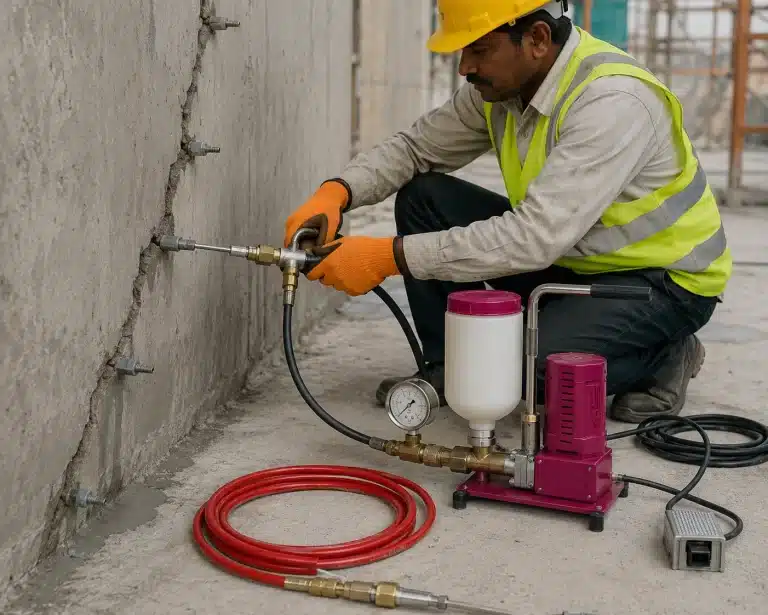
Epoxy injection grouting is a specialised repair method where liquid epoxy resin components are mixed and then injected under pressure into cracked or honeycombed concrete. Unlike traditional cementitious mixes, Ultrafill epoxy injection grout does not lose volume during curing. It has excellent free-flowing properties and is completely waterproof. Due to its low viscosity, it penetrates into minute gaps in the substrate to avoid minimizing the risk of future structural deterioration. Once fully cured, the resin forms an impermeable barrier that bonds deeply with the surrounding concrete mass and achieves compressive and tensile strengths that are often higher than the original structure.

How Does PrimeGrout UltraFill Epoxy Resin Injection Grout Work?

PrimeGrout UltraFill is a two-component, low-viscosity epoxy injection grout designed to restore the structural integrity of cracked and honeycombed concrete. After Components A and B are mixed using an injection grouting pump, the low-viscosity resin flows deep into fine cracks, internal voids, and gaps around reinforcing steel. As the epoxy cures, it forms a rigid, high-strength bond that permanently seals the crack while restoring load transfer within the concrete.

Technical Performance: Primegrout Ultrafill Epoxy Resin Injection Grout

High Mechanical Strength
PrimeGrout UltraFill EP Series delivers a compressive strength of 60–70 MPa, tensile strength of 20–30 MPa, and flexural strength of up to 35 MPa (grade dependent), making it suitable for structural crack repair.

Excellent Crack Penetration
With a low viscosity ranging from approximately 150 cps to 1000 cps, the grout penetrates deep into fine cracks, honeycombs, and internal voids, ensuring complete filling and effective pressure injection.

Easy Application
The epoxy grout offers a pot life of 10–80 minutes (depending on grade and temperature) and can be applied at temperatures between 5°C and 40°C, providing flexibility for different site conditions.

Durable Performance
After curing, PrimeGrout UltraFill becomes non-toxic, impermeable, non-shrink, and chemically resistant, while developing excellent adhesion with the parent concrete for durable repairs.

Step-by-Step Application Guide Of Resin Epoxy Grout

1. Surface Preparation

  • Clear out all surface dust, oil, dynamic loose particles, and debris using compressed air or flushing methods.
  • Ensure the target parent substrate is structurally sound and prepared per project specifications.

2. Port Installation & Surface Sealing

  • Before installation, seal the alternate small holes which is happened because of deterioration with putty.
  • Install injection nipples/nozzles along the path of the crack line at uniform intervals.
  • Seal the exterior crack surfaces between ports and shutter forms thoroughly to prevent material leakage during pressure grouting.

3. Precision Mixing

  • Epoxy resins are two-component systems (Part A base and Part B hardener).
  • Pour Component B directly into Component A and mix thoroughly at slow speeds for 1 to 3 minutes to avoid entrapping air pockets

4. Pressure Grouting Execution

  • Inject the blended epoxy-resin grout into the lowest nozzle first using appropriate grouting equipment.
  • Continue pumping until resin flows steadily from the adjacent port, then cap the lower port and move upward. The pressure for epoxy-resin injection grout is up to 200 PSI.
  • Critical Note: Always complete the application within the material’s specified pot life (typically 15 to 30 minutes depending on ambient temperature).

5. Cleaning & Safety

  • Clean tools and injection pumps immediately after use with dedicated thinners.
  • Wear protective safety gear, including gloves and eye goggles, during handling and mixing. Once fully cured, high-grade epoxies become non-toxic and structurally inert.

Where to Use Epoxy Injection Systems ?

  • Structural Concrete Repair: Columns, support beams, lintels, and pre-cast concrete sections.
  • Infrastructure Works: Highway bridges, retaining walls, box culverts, and road pavements.
  • Industrial Facilities: Heavily loaded plant floors, machine foundations, and driveways exposed to chemical spills.
  • Honeycombed Concrete Fixes: Filling voids caused by poor compaction around high-density rebar arrangements.
  • Waterproofing the concrete: By filling voids, it also waterproofs the concrete structure.

Conclusion

Structural cracks and honeycombing do not have to lead to expensive demolitions or structural failures. Using a high-performance epoxy-resin grout, engineering teams can effectively reach deep micro-cracks, stop water from entering, and restore the strength of the structure without shrinking.

Whether you are repairing industrial floors that carry heavy loads, bridge decks, or columns, selecting the right low-viscosity grout ensures your concrete remains strong, safe, and long-lasting.

PrimeGrout®UltraFILL EP-100: It’s a low-viscosity epoxy injection grout designed to penetrate deeply into concrete cavities, microvoids, and areas behind reinforcement, providing reliable structural repair and enhanced adhesion.

PrimeGrout®Ultrafill EP-200: It’s a specially prepared resin-based, low-viscosity flow for filling cracks and honeycombed concrete substrates. It has excellent free-flowing properties and absolute waterproof.

PrimeGrout®Ultrafill EP-300: It is a moisture-insensitive, high-performance, low-viscosity epoxy injection grout. It features excellent penetration into the concrete substrate. It reduces repair work, cutting down on time.

FAQ

1. What is epoxy resin injection grout?

Non-shrink grout is a high-performance grouting material that maintains its volume after curing and prevents void formation.

PrimeGrout UltraFill is a high-performance, low-viscosity epoxy injection grout designed to repair cracks, honeycombs, and voids in concrete.

Yes. Its low-viscosity epoxy formulation allows it to penetrate fine cracks, voids, and cavities that conventional repair materials cannot effectively fill.

Yes, once fully cured, it becomes completely waterproof, chemical-resistant, and non-toxic.

Yes. It is designed to restore the integrity of cracked concrete members such as beams, columns, slabs, and other structural elements through epoxy injection grouting.

Facebook
Twitter
LinkedIn

The Science of Polymer Waterproofing: Next-Gen Substrate Protection

The Science of Polymer Waterproofing: Next-Gen Substrate Protection Water damage is a major cause of structural failure in concrete buildings. When moisture penetrates concrete, it rusts internal steel rebar, causes the surface to crack and flake off (spalling), and creates unsightly white salt deposits (efflorescence). While traditional asphalt and bituminic

Read More »