Injection Grouting: The Science Behind Grout Injection

Injection grouting shows its strength, not as an exterior repair, but as an internal
solution.Cracks, voids, and hidden water pathways are among the most common, as well as the
most underestimated, threats to concrete structures. In basements, tunnels, bridges, or water
dams, even the tiniest crack may lead, in time, to rust, loss of strength, and costly repairs.

What Is Injection Grouting?

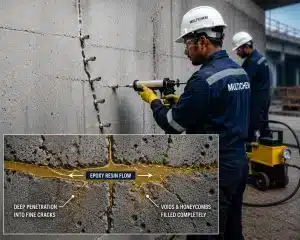
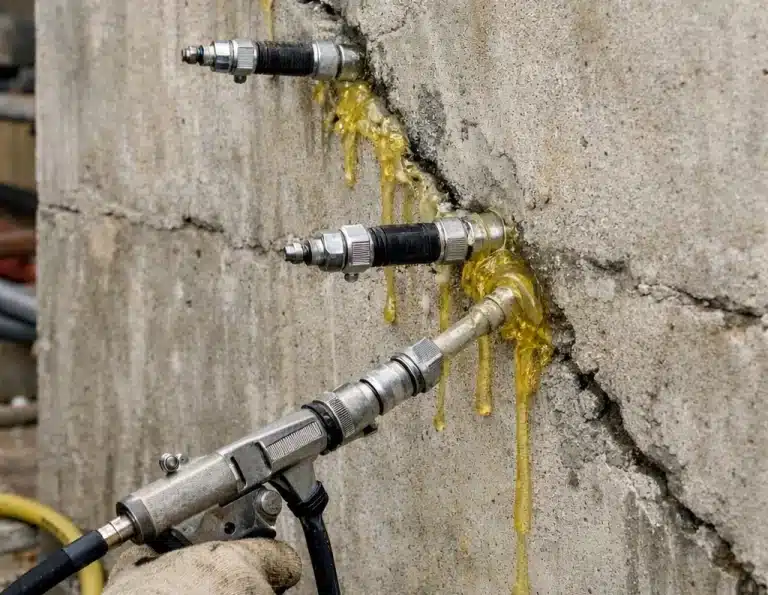
Injection Grouting is a method of repair in which an injectable form of grout is used to press the
formula inside the honeycombed concrete areas. Unlike the other method of application, the
injection grout is used inside the concrete to make it intact.
The chemical grout injection systems used may depend on the problem, such as structural
cracks, water leakage, and soil stabilization, and may include systems like epoxy resin to
polyurethane grout injection systems.

Where to lay Epoxy Screeds?

  • Water tanks and reservoirs
  • Swimming pools and aquariums
  • Bridge decks and tunnels
  • Marine and coastal structures
  • Sewage and water treatment plants
  • Parking slabs and driveways
  • Patios, floors, roofs and concrete walls
  • Power plants and turbine halls
  • Industrial processing zones

Anywhere you expect constant moisture, chemicals,or mechanical stress, these systems outperform regular coatings.

Why Injection Grouting Works When Other Methods Fail

Concrete behaves like a hard sponge. It absorbs moisture, allows water migration, and hides
internal defects that are invisible on the surface. Injection grouting works because it:
● Penetrates deep into micro-cracks and voids
● Bonds with parent concrete
● Stops water flow under hydrostatic pressure
● Strengthens weakened sections internally
This makes injection grouting a preferred method for permanent waterproofing and structural
rehabilitation rather than cosmetic repair

Types of Injection Grout and Their Applications

1. Epoxy Injection Grout for Structural Strength

High-performance epoxy injection grouts offer non-shrink behavior, excellent chemical
resistance, and long-term durability
Epoxy injection systems are ideal for :
● Cracked beams and columns
● Honeycombed concrete
● Industrial floors and slabs
● Structural repair where load transfer is required

2. Polyurethane Grout Injection for Active Water Leaks

When cracks are wet or actively leaking, polyurethane grout injection becomes the most
effective solution.Depending on site conditions, both single-component and two-component
polyurethane systems are used:
● Single-component PU grouts react with water to form a hydrophobic, flexible foam,
ideal for moving cracks and joints
● Two-component PU grouts expand rapidly and are suitable for stopping heavy water
ingress under pressure
These systems are commonly used in basements, tunnels, retaining walls, water tanks, and
sewage treatment plants .

3. Cementitious Injection Grouting for Micro-Crack Penetration

Ultra-fine cementitious injection grouting is used where traditional cement slurry fails to
penetrate.
They are commonly used for:
● Soil stabilization
● Dam foundation
● Tunnels and underground structures
● Crack sealing where chemical grouts are not suitable
Ultra-fine injectable grout provides non-shrink performance, high strength, and long service life.

Choosing the Right Chemical Grout Injection System

Structural cracks → Epoxy injection grout
Active water leakage → Polyurethane grout injection
Micro-cracks or soil voids → Ultra-fine cementitious injectable grout
This is usually the case when the grout that is used is the incorrect type, although Multichem
have a variety of products.

Following are the products designed for different application:

Hydrofom 100: A high-performance, two-component polyurethane injection grout developed to
permanently stop water leakage in concrete. Once injected, it reacts and expands inside cracks
and hidden voids, sealing them from within.

Hydrofom 101: A two-component, fast-reacting polyurethane foam designed to instantly stop
heavy water leakages. Its rapid expansion makes it ideal for emergency water-stopping
applications.

Hydrofom 200: A single-component polyurethane injection grout that reacts with water to form
a stable, flexible, and durable foam structure. Ideal for sealing leaking cracks in concrete
structures.

Hydrofom 201: A single-component, hydrophobic polyurethane resin that reacts with water to
create a flexible grout, effectively sealing cracks and joints in concrete surfaces. Recommended
for structures experiencing movement, applied using a single-component injection pump.

PrimeGrout SuperAdd-250N : A plasticized expanding grout admixture is supplied in powder
form. The material is a combination of a plasticizing agent and expansion producing additives.
The plasticizing agent allows the use of a reduced water/ cement ratio with consequent
increased strengths and durability.

MultiGrout SuperGel: Ready-to-use; nano particle sized, zero voc, water borne, colloidal silica
based injection Grout is a blend of nano silica, specialized additives and very low viscosity

MultiGrout UltraFin-10: Ultra-fine is a high strength, non-metallic, non-shrink grout is a blend of
Portland cement, siliceous aggregates and specialized additives that effectively penetrates into
micro cracks of concrete. Particle size: <10 micron
ious substrates. Particle size: <40 micron

MultiGrout UltraFILL EP-100 : UltraFILL EP-100 is specially prepared low viscosity resins
based chemical used for grouting and filling of cracks and honeycombed concrete surface. It
has ability to penetrate into the recess of concrete members and behind the reinforcement of
the member under repair.

MultiGrout UltraFILL EP-200: UltraFin-40 being in ultra-fine in size, penetrate into any micro
cracks in the structure. This high performance grout, even when placed at a flowable
consistency, provides rapid strength development, complete shrinkage correction, and excellent
bond to various substrates. Particle size: <40 micron

MultiGrout UltraFin-40: UltraFin-40 being in ultra-fine in size, penetrate into any micro cracks
in the structure. This high performance grout, even when placed at a flowable consistency,
provides rapid strength development, complete shrinkage correction, and excellent bond to various substrates .Particle size: <40 micron

Injection Grouting: A Long-Term Investment, Not a Temporary Fix

In today’s construction and infrastructure environment, repairs are no longer judged by how
quickly leaks stop-but by how long they stay stopped. Injection grouting, when designed
properly and executed with the right chemical grout injection system, delivers reliable,
long-lasting results.
Whether it’s the sealing of a leaking basement, strengthening of a cracked beam, or stopping
water ingress in critical infrastructure, injection grout solutions continue to be among the
strongest repair technologies available.

Facebook
Twitter
LinkedIn
esd flooring

ESD Flooring That Protects Equipment, People, and Compliance

ESD Flooring That Protects Equipment, People, and Compliance A Practical Guide to Conductive & Static Dissipative Epoxy Floor Systems In electronics manufacturing, cleanrooms, defense facilities, and data-driven environments, electrostatic discharge isn’t a minor risk it’s a silent operational threat. One uncontrolled static discharge can: Damage sensitive electronic components Cause product

Read More »