Flooring forms the base of any interior and exterior scheme and with the many choices available, it can be easy to get carried away and forget about the practical aspects that need to be taken into consideration. By their very nature, floors are subject to the most use and therefore need to be able to stand up to knocks, spills and furniture, not to mention human and animal traffic. Purchasing cheap floor systems may save you money initially, but it will not last long, looking worn and tatty before its time. Flooring really needs to be viewed as an investment and there are a number of options available to suit all levels of budget. The first thing to decide upon is whether to go for hard or soft flooring.
“It serves as the foundation of the house interior. If you have good quality flooring, it will always look good even without all the furniture’s and wall decors.”
‘FLOOR’ AN INTEGRAL PART:
During the last thirty years, the protection of concrete floors has gone from essentially nothing to a fairly sophisticated process of some type of protective coating or surfacing. The main purpose, of course, is to provide protection to the slab from deterioration or contamination, or to provide some added benefit such as aesthetics, wear, non-skid, chemical resistance, and ease of maintenance, physical performance, and a myriad of other properties. We must remember that no other surface in a building takes more abuse than floors, regardless of the type of building, whether it is industrial or commercial.
Many people in the world spend the major part of their time inside buildings, particularly in new buildings. The air exchange rates have become low as these buildings are more or less sealed in order to save energy. Therefore, substances that might pollute air inside a building have become a part of discussion because their accumulation might affect people’s health.
Floor coating systems are subject to a wide range of abusive conditions, from chemical attack to physical damage. Some of the common causes of damage to floor coating systems are:
- Opening the facility for traffic, and use too soon after application of the coating system, before proper cure has occurred.
- Not cleaning up chemical spills within the designed time period of the flooring system.
- Dragging heavy pointed metal or concrete objects across the flooring system.
- Not repairing damaged areas in a timely manner.
- Excessive cracking in structural concrete slabs.
- Moisture drive related problems.
- Moving pallets by shoving across floor coating system. Pallets should be lifted and placed in required location.
FLOORING SYSTEMS:
Epoxy Flooring:
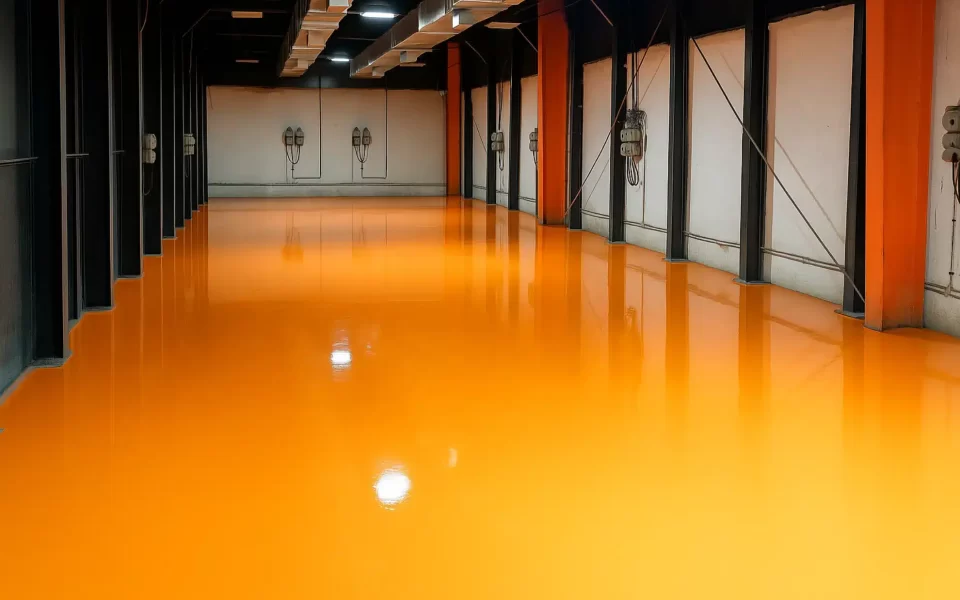
Epoxy coatings are extensively utilized in protective coatings and flooring markets due to their generally high level of mechanical properties, corrosion protection and chemical resistance. In the last few decades, epoxy coatings have evolved from high VOC systems to more environmentally friendly technologies, like high solids coatings, solvent-free coatings, powder coatings, and waterborne coatings.
Fast dry, surface tolerant, epoxy coating technology
Faster drying epoxy coatings and curing at colder
temperatures have long been goals of protective coatings suppliers. Improved production rates, reduced time for job completion, as well as the ability to lower application cure conditions and extend the painting season are attractive to coating supplier, applicator, end-user and owner alike.
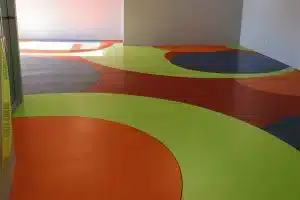
Protective coating suppliers have used four approaches to develop epoxy coatings with improved dry times and low temperature cure capability.
- Accelerators and catalysts
- Faster reacting epoxy resins
- Faster reacting amine curatives
- Blends and hybrid
Curing Technology
New developments in waterborne epoxy curing agent technology will next be described. At this time, they are often not driven primarily by environmental regulations. Rather, they provide unique technical solutions to overcome well known problems that have remained unsolved for many years in our industry, like adhesion over green concrete, blistering promoted by osmotic pressure, poor stain resistance against acidic foods, and color stability.
Conventional epoxy coatings and flooring formulations are typically applied after the concrete is completely cured. The recommended wait is 28 days to ensure that residual moisture is minimized and does not interfere with adhesion. Application prior to this period with 100% solids formulations has often resulted in complete failure at the epoxy/concrete interface. A new waterborne curing agent was designed to allow an epoxy primer to apply over freshly poured concrete (green concrete). A study of primer and curing compound formulations based on this curing agent over green concrete fabricated with different finishes was performed. The primer was evaluated over two concrete formulations. A 27 MPa concrete mix was used to simulate a commercial floor. Concrete Formulation 1 was finished using a steel trowel while Concrete Formulation 2 was finished either by broom finish or a mild shot blast after three days.
Characteristics of Epoxy Coatings:
- Epoxy coatings are used as industrial floor coatings because of their chemical resistance, durability, low porosity and strong bond strength.
- An Epoxy coating consists of a ‘base’ and a ‘curing’ agent. The two components are mixed in a certain ratio. A chemical reaction occurs between the two parts generating heat and hardening the mixture into an inert, hard ‘plastic’.
- Epoxy coatings yellow and/or chalk when exposed to UV light especially common when exposed to direct sunlight. This yellowing can be a real problem for some applications. This can be hidden by choosing a darker color of pigmented epoxy. Clear epoxies will yellow and may even cloud up. For this reason, epoxies are sometimes top coated with latex, urethanes, and polyaspartics that will retain their color and attractive gloss. This is recommended if color stability or matching colors is important.
- After the two epoxy parts are combined there is a working time (pot life) during which the epoxy can be applied or used. Generally, the pot life will be anywhere from minutes to one hour. At the end of the pot life the mixture becomes very warm and further accelerates the hardening.
- Epoxy resins will harden in minutes or hours, but complete cure (hardening) will generally take several days. Most epoxies will be suitably hard within a day or so, but may require more time to harden before the coating can be sanded.
- In theory, a temperature change of 5–10 degrees C will double or half the pot life and cure time of an epoxy coating. Higher temperatures will lower the viscosity (thin) the epoxy, but also reduce the working time a person has to apply the epoxy.
- Generally, epoxy floors become too thick and cure too slowly to be applied at temperatures below 10–12 degrees C. Temperatures between 15- and 30-degrees C are best for installation. After the epoxy has cured, it can handle temperatures well below zero degrees C and in the case of high temperature epoxy coatings above 150 degrees C.
- Standard epoxy floors will begin to soften at about 60 degrees C, but will re-harden when the temperature is reduced. For common epoxies this temperature is approximate upper end of working temperature range of epoxies. Special high temperature epoxies are available but come with added cost.
- By nature, epoxy resins are hard and brittle. Additives can be added to epoxies that make them less brittle, but generally at the loss or reduction of other positive epoxy properties such as chemical resistance.
- There are special epoxy formulations that have increased chemical resistance, increased temperature resistance, the ability to be applied under water and enhance resistance to yellowing and UV damage.
- Epoxies are expensive, but there are ways to ‘water down’ the epoxies with less expensive solvents and/or non-solvent thinners. Diluted down epoxies are common with floor epoxies where pricing pressures are especially strong. To a large degree you do ‘get what you pay for’.
- Other clues of lesser quality epoxy coatings include ‘induction time’ (after mixing the two components the mixture must sit for several minutes to ‘self-cook’ before being applied).
- As they cure most epoxy resins ‘blush’. A blush is a waxy coating that forms on the surface of the curing epoxy due to moisture in the air or on the surface of the epoxy coating. This film or blush created must be removed before applying subsequent coats. Most epoxies blush to some degree especially when applied during high humidity.
- The best time to recoat epoxy is within 12–48 hours after the initial coat. Because epoxies take days to reach full cure, a second coat applied shortly after the first coat will partially fuse to the first coat rather than just forming a simple mechanical bond. If the recoat “window” is exceeded it is necessary to mechanically abrade the surface to create a mechanical bond for subsequent coats to adhere.
- While epoxy floors are very common, for serious and demanding applications the epoxy may be mixed with, or applied under and above, quartz (sand) or aluminum oxide grains. Either way, the result is really a quartz or aluminum oxide floor, held in place with the epoxy. The aggregate is much more durable and wear resistant than the epoxy alone.
Chemical and Stain Resistance:

The chemical resistance and spot resistance were benchmarked against established water-based epoxy technology. Good solvent resistance is observed in many water-based systems. However, this new curing agent offers marked improvements in acid resistance.
PU Flooring:
Polyurethane topcoats are commonly used in the construction industry over functional floor coatings or as sealers for concrete. In response to the need for ambient temperature curing coatings with low solvent emission levels, has developed two-component waterborne polyurethane coatings with properties similar to those of two-component solventborne polyurethane coatings. For many years, solventborne polyurethane topcoats have been the standard for flooring due to their very good properties and ease of application. However, tighter VOC regulations and increasing sensitivity to solvent odors make it undesirable to apply solventborne topcoats.
PU floorings are more suited to the following: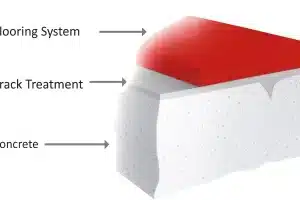
- Suitable for light to medium traffic
- Hygienic finish
- Mat or gloss finish
- Flexibility
- Easy to clean and maintain
- Good chemical resistance
- Range of colours
Multichem has developed a range of polyurethane self-smoothing screed systems available in a gloss or matt finish. The range is designed to create a flexible, smooth seamless finish where an erratic floor surface is encountered. The special blend of polyurethane resins and aggregates flow out to the undulations of the substrate. Once cured, this system creates a seamless, hygienic finish while offering a long-term durable floor finish.
PU floorings are particularly suitable for: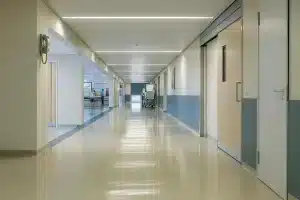
- Warehouses
- Packing areas
- Pharmaceutical manufacture
- Laboratories
- Electronics
- Industrial process areas
- Canteens
- Retail areas
MMA and Vinyl Ester Floorings:
There are some key benefits we derive by using MMA and VE-based flooring. Where fast turnaround is required, MMA is the right candidate to be utilised. Where solvents are used, VE-based flooring wins the requirement.
Selection Guidelines for Flooring Products:
Evaluate the surface
The flooring specialist must be able to provide a complete program from conception to long-term maintenance. The process should include the following:
- The first step in the selection process is to evaluate the existing surface to determine what you are working with. The surface must be structurally sound, clean, and must not be contaminated with any foreign material that could interfere with the bond of a new coating system. This includes concrete curing compounds.
- Is the flooring distressed in any way? Does the surface have cracks, spalls, or unevenness? Does the coating system require a level floor or one that slopes to a drain? Patching, repairing, and leveling are as important as the coating system and would require a whole separate article to discuss thoroughly. It is important to say, however, that any material used to level, patch, or slope must be compatible with the total system. A cheap, low-performance patching and leveling material can ruin an otherwise good coating. It is also good practice to allow the same contractor that is doing the final work to make any needed repairs.
- Surface preparation step is the most important step in the installation process and is critical to long-term performance of the total system. There are many ways to prepare the surface. The coating selection (thin film or thick) will have a bearing on the type of preparation.
- It is also important to remember that new concrete requires proper preparation just as does any old surface. Curing compounds must be removed, a proper profile or roughness achieved, and any surface laitance removed.
Consider the Performance Conditions
There are four major areas of abuse that will dictate what a flooring system needs:
- Chemical exposure. Severity of exposure and types of chemicals are both very important. Materials differ widely in chemical resistance, making identifying the exposure very important. Common splash and spills also are far less critical than constant immersion.
- Abrasion. The amount of wear or traffic a surface will take is an important criterion. Whether there will be steel-wheeled traffic or rubber-wheeled traffic is critical. Any surface exposed to steel-wheeled traffic requires special treatment for long-term wear.
- Impact. Heavy loads and direct impact require a heavier build or thicker floor system.
- Thermal Shock. Temperature fluctuation or thermal shock is an important condition that must be considered. Thermal shock, such as steam cleaning of the floor surface, will cause a loss of bond from thermal expansion if the floor system is not chosen properly. The coefficient of expansion of most coating systems is much higher than for concrete and must be carefully considered when selecting a material.
Once the degree of severity of the major areas of abuse is identified, we must rank them in order of importance for the particular project. This will provide a major focus for what is needed in terms of material and applied thickness. The last of the material selection process is possibly the most important. It involves how the coating project is going to look aesthetically, how it’s to be applied, what the time frame for installing the system may be, and last, but certainly not least, what are the budget parameters.
Other considerations
There are other points which are often overlooked when selecting or specifying a floor coating system. These lesser considerations don’t necessarily contribute to the function of the system but are important as far as being able to install a particular system and assuring owner satisfaction.
- Aesthetics. The final appearance of the floor surface is more important than many people perceive it to be. How an owner thought the floor was going to look versus the final appearance is sometimes widely divergent. Today, the same performance characteristics can be obtained with a variety of decorative appearances and surface textures.
- Installation parameters. In many cases, a flooring project has a very tight installation schedule. This limits many systems in how long it takes to install a given material. In occupied areas, the odor of some solvent-based systems or the inherent odor of the material itself will limit its use. Temperature of the surface at the time of installation is critical in selecting a material. Some systems, such as epoxies, are very temperature-sensitive and can vary widely in cure time at lower temperatures.
- Life expectancy. Owners want a flooring system that will last forever and will be guaranteed. In actuality, a given system will require maintenance periodically. Maintenance procedures must be clearly outlined and understood for a realistic life expectancy.
- Economics. Economy is the top requirement. At times, low-cost systems will prevail at the expense of more durable systems. Generally, when other parameters are exhausted, you get what you pay for. Another generally accepted maxim is that the thicker the applied system, the better the performance.
Review material properties and application procedures
The primary reason to go through a material selection process is to get the proper material for the application under consideration. It is critical to review technical data, performance characteristics, and installation procedures for those that have survived the elimination process thus far. The technical data and performance review can be difficult for most engineers, owners, and specifiers because there is a lack of standard form of data presentation. The following table will provide some differences in performance requirements for different types of flooring products. In many cases, the reviewer must compare test method to test method to find the differences in the reported values. Professional assistance is suggested to completely understand the data. Remember the key conditions they must meet for best performance.
Surface preparation
This step is the key to the success of any flooring products to be used. Surface preparation needs very careful attention before we proceed for flooring work. Concrete surfaces may be contaminated with oils, greases, dirt and chemicals; in addition to removing these contaminants, the surface should also be free of curing membranes and form release agents. This is best accomplished by one of the following methods:
Mechanical Blasting
The preferred method of surface preparation of concrete slabs is vacuum-grit blasting, grit blasting, or mechanical scarification. These methods are effective in the removal of laitance (the weak alkaline surface residue), curing compounds, dirt, and dust. Vertical surfaces must be either grit-blasted or cleaned with hand-held mechanical equipment.
Acid Etching
Acid Etching, although commonly used, is one of the least desirable methods of surface preparation. This is because it introduces water and acid to the substrate, is difficult to recover and is not as effective in obtaining a uniform surface profile.
Solvent Stripping
Stripping is the removal of existing coatings by attacking them with an exotic chemical/solvent-based mucous-type compound, usually containing methylene chloride. Complete protective clothing and respiratory equipment should be worn when working with these compounds. All old paints should be removed in order to attain good adhesion of a new coating to the concrete.
Degreasing
Any oil and/or grease contamination on the concrete must be removed prior to coating. Commercial degreasers (such as trisodium phosphate) and removal agents are available that have varying effects on embedded oils or grease. Also, scrubbing with liquid caustic soda will usually attack stubborn greases. For animal fats, use a 50% solution of caustic soda and water. After application, thoroughly flush the surface with potable water. This process should be repeated until the floor is completely free of oils and greases.
Steam Cleaning
Cleaning concrete with steam is an effective means of removing heavy deposits of oils and greases. It consists of cleaning the surface with a jet of high-pressure steam sufficient to remove contaminants. Detergents or non-solvent emulsifying agents intended for use with steam cleaning equipment may also be used. If these compounds are used, the surface should be thoroughly and repeatedly washed off with potable water. The surface should be allowed to thoroughly dry.
Primer
Use of primer improves adhesion and bond strength to the subfloor. Also allows direct ceramic tile installation on many difficult-to-bond-to substrates such as metal, unscarified glazed ceramic, and gypsum. For peel and stick tile installation, primer can be used on dry, porous concrete, gypsum cement underlayments, and plywood. The primer may also be used to promote bond over cold-rolled steel substrates.
- FloorPrime: One product for all substrates
- Solvent free – zero VOC
- Easy to use – apply with brush or roller
- Available in 1 quart and 1-gallon jugs, 5 gallon pails and 50-gallon drums
Intermediate/Topcoat preparation
Once primer has dried as per requirement of products, intermediate layer is laid down again as per guidelines laid down by manufacturers.
For further details contact:
Multichem Industries Pvt. Ltd.
Phone No: +91 9619091025
E-mail: info@multichemgroup.net
Web: www.multichemgroup.net