Why Traditional Waterproofing Fails and How Superflex Plus Polyurethane PU Waterproofing Coating Changes the Game

Building envelopes are under constant thermal expansion, moisture ingress, and atmospheric chemical warfare. Ordinary paints or traditional bituminous membranes are not always able to adapt to the movement of the structure, resulting in premature leaks, spalling concrete, and internal dampness. To address these issues, high-performance water-based PU coating systems such as Multichem’s Superflex®-PLUS are long-lasting, environmentally responsible liquid-applied membranes engineered for both roof and wall waterproofing.

pu waterproofing coating for roof and wall

Why Choose a Water-Based PU Superflex® Plus?

1. High Elasticity & Crack-Bridging Capability

Concrete buildings change in shape throughout the year due to seasonal variations. The product has an elongation rating of 400%. Superflex®-PLUS is very expandable beyond the normal ASTM specification Requirement of 100%. This elastomeric property enables the PU waterproofing coating to rewind and withstand any horizontal forces.

Structural micro-cracks up to a 2 mm width are able to be protected without breakage, providing this long-term protection.

2. Resistance to Atmospheric Gases & De-Icing Salts

In addition to being water-resistant, this water-based PU barrier protects from carbon. De-icing salts, acid gases, and carbon dioxide (CO₂). This makes it ideal for protecting exposed. Across a range of concrete structures, such as flyovers, bridges, parapets, or podiums, against carbonation and internal rebar corrosion.

3. Low VOC and Eco-friendly system made of one component

Unlike two-pack solvent-borne polyurethanes, which need to be precisely mixed in the field and emit VOCs, this product doesn’t release them.

Single-component water-based systems are free of harmful volatile organic compounds (VOCs). Easy to apply directly from the container using a brush or roller, packaged at no risk when cured, and non-toxic,or spray.

Application Protocol for Roofs and Walls

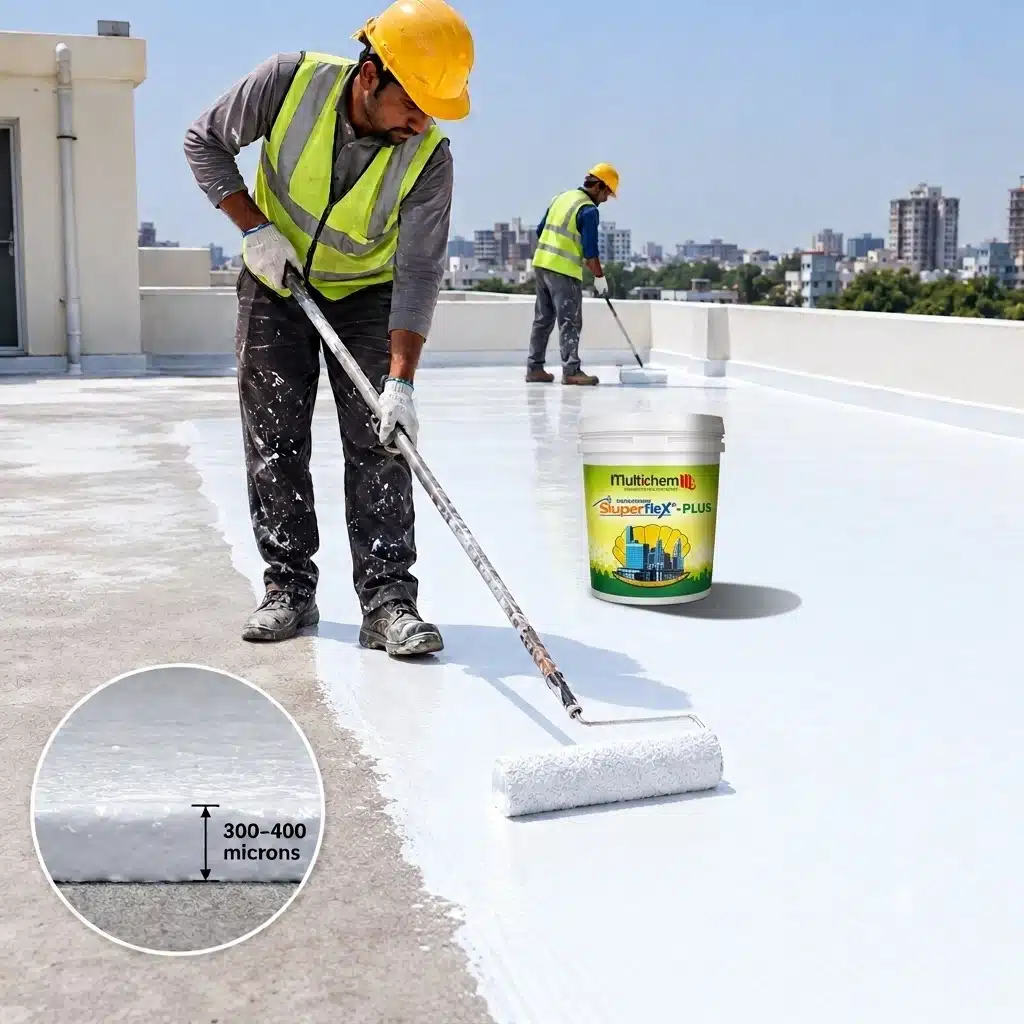
Follow this systematic procedure to achieve the recommended dry film thickness (DFT) of 0.6 mm to 1.0 mm (1.3 kg/m² to 2.2 kg/m² over 2 to 3 coats).

Step 1: Substrate Preparation

  1. The material to be bonded, such as concrete or cement plaster, should be fully cured (28 days old or more).
  2. Clean using water blasting or mechanical grit to remove surface laitance/dust/lags, oil, or existing biological growth.

Step 2: Saturation & Priming

Dampen the outdoor concrete surface well, but do not allow it to stand to a saturated surface-dry (SSD) condition. Use a separate priming coat for highly porous substrates, for example, Multithane Primer 21 or Aquablock Primer. Use compatible repair mortars such as Microtop or Surfix Level-Coat to be used for the sealing of surface imperfections and honeycombs.

Step 3: Detailing & Crack Treatment

Place non-woven glass reinforcement fabric (Fibrecon G55) over cracks in movement or structural joints.

Properly make fillets at wall-to-floor joints with the reinforcement Deckcoat Mortar Reglet.

Step 4. Use Layered Coating Application

Basecoat: Spread this first coat (~300 micron thickness) out evenly with a brush, roller, or spray.

Topcoat: Second coat, which is applied cross-directionally after the first coat of paint stabilises (usually about 1 hour – 24 hours depending on temperature). For example, a Superflex Plus Topcoat in White will have a solar reflectance of 0.92.

Critical Application Considerations

Never dilute the coating with water or solvents – this compromises the cross-linking mechanism and the mechanical strength.

Temperature & Freezing: Avoid packages that have been in freezing temperatures. Keep in a moderate-temperature room (25°C below).

Clean-up: Wash all brushes, spray equipment and tools right after use with water, before the polymer cures.

Conclusion

When properly applied, Superflex® Plus coating can be an effective and versatile solution for waterproofing roofs and walls. A water-based PU coating can create a continuous, flexible and waterproof coating that will help prevent damage from rainfall, wetness and the environment.

But waterproofing performance over time is more than the coating. Correct surface preparation and crack and joint treatment, correct coating thickness, drainage, curing and regular maintenance are all essential. As a complete waterproofing system, and not just a protective coating, the use of PU waterproofing coating means building owners and contractors can expect a more reliable and durable waterproofing solutions for roofs and walls.

FAQ

It has a very high elasticity, is able to bridge cracks, is waterproof and resistant to atmospheric gases and de-icing salts.

Up to 2 mm wide structural micro-cracks can be bridged without rupturing by the coating.

(2 to 3) coats are used for a dry film thickness of 0.6-1.0 mm, which is recommended.

Yes, it can be used on properly prepared and fully cured concrete or cement-plaster surfaces.

Performance is influenced by surface preparation, crack and joint treatment, coating thickness, drainage, curing, and regular maintenance.

Facebook
Twitter
LinkedIn
Cementitious waterproofing

LeakShield Cementitious Waterproofing Coating for Durable Concrete

LeakShield Cementitious Waterproofing Coating for Durable Concrete Cementitious waterproofing provides a reliable solution for protecting concrete and masonry surfaces from moisture and water ingress. LeakShield by Multichem Group is a single-component cementitious waterproofing coating designed to help protect concrete, brickwork, blockwork and cement-rendered surfaces from water and moisture. It is

Read More »