Industrial Waterproofing Systems: Complete Guide to Waterproofing Products for long term performance

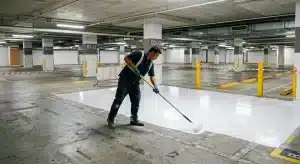
Imagine investing millions into an industrial facility only to see cracks, leaks, and corrosion appear within a few years. The culprit here is Inadequate waterproofing. In high-performance environments, the right waterproofing solutions can make the difference between durability and deterioration.

Without the right waterproofing chemicals and systems in place, even the strongest concrete can fail much earlier than expected.

Why Industrial Waterproofing Is Critical

Industrial installations face harsh conditions in contrast to residential areas:

  • Continuous contact with water, chemicals, and abrasion
  • Heavy mechanical loads and vibration
  • Thermal expansion and contraction
  • Aggressive environments like STPs, ETPs, and coastal zones

Structures may be affected due lack of proper waterproofing chemicals:

  • Reinforcement corrosion– When steel bars are exposed to water, they rust, tend to become enlarged and crack after that.
  • Concrete deterioration– On-going moisture exposure deteriorate concrete, decreasing its strength and longevity.
  • Leakage in basements and foundations– Lack of proper basement waterproofing and foundation waterproofing leads to persistent seepage and dampness.
  • Poor service life– Uncontrolled moisture greatly reduces the life of industrial buildings.
  • Formation of efflorescence– Water flow transports the salts to the surface leaving white deposits and showing internal damages.
  • Mold and microbial growth– Damp conditions favor the growth of molds and affect structural integrity and hygiene.
  • Weakened structural integrity- The long-term effects of water on concrete include weakening of the concrete, thereby reducing its load-bearing strength.

Industrial waterproofing spans across multiple critical zones:

Water & Wastewater Structures

  • STP tanks
  • Effluent treatment plants
  • Clarifiers and sumps

Underground Structures

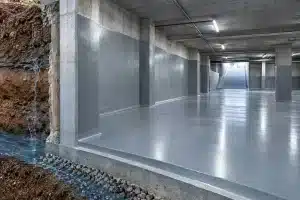
  • Basement waterproofing
  • Raft foundations
  • Retaining walls

Exposed Areas

Heavy-Duty Industrial Zones

  • Chemical plants
  • Manufacturing units
  • Warehouses

Core Functional Requirements of Waterproofing in Industrial Environments

An effective industrial waterproofing system should provide:

  • Seamless coverage over wide spaces
  • Chemical resistance (acids, alkalis, effluents)
  • Crack-bridging capacity for structural movement
  • Strong bondage to concrete and steel
  • Durability under harsh conditions

Industrial Waterproofing Systems Types:

Polyurea is latest, quickest and most advanced waterproofing solutions available today in the market.

Key Features:

  • Quick curing (in several seconds)
  • Membrane with smooth edges and free of joints.
  • Excellent chemical and abrasion resistance

Applications:

  • STP & ETP tanks
  • Industrial floors
  • Secondary containment areas
  • Concrete and metal constructions

Best for: High-performance settings that need quick turnaround.

PU coats can be applied in various industrial applications.

Key Features:

  • Flexible and elastic membrane
  • Good crack-bridging properties
  • UV-resistant (for exposed areas)

Applications:

  • Terrace waterproofing
  • Wet areas and podium decks
  • Water-retaining structures

Best in: Areas with movement and weather exposure areas.

This system works from within the concrete.

Key Features:

  • Forms crystals inside pores and cracks
  • Self-healing capability
  • Permanent waterproofing

Applications:

  • Basement waterproofing
  • Water tanks and foundations
  • Raft slabs

Best for: Deep protection and internal sealing is needed.

Added during the batching of concrete.

Key Features:

  • Reduces permeability
  • Improves concrete density
  • Cost-effective solution

Applications:

  • Foundation waterproofing
  • Raft slabs
  • Structural concrete

Best for: Preventive waterproofing at construction stage.

The traditional system that is most widely used.

Key Features:

  • Simple to use (brush/roller)
  • Good bonding with concrete
  • Cost-effective

Applications:

  • Internal wet areas
  • Water tanks
  • Sewage structures

Best for: Simple waterproofing requirements.

A modified version of cementitious systems.

Key Features:

  • Increased flexibility and adhesion.
  • Better crack resistance
  • Durable coating

Applications:

  • Terrace waterproofing
  • Balconies and bathrooms
  • Repair and rehabilitation

Best use: Better performance compared to conventional coatings.

Engineered to be flexible and weatherproof.

Key Features:

  • High elongation
  • UV and weather resistance
  • Seamless coating

Applications:

  • Uncovered Roofs and exposed
  • Facades
  • Industrial sheds

Best on: External surfaces that are exposed to the extreme weather.

Challenges in Industrial Waterproofing

Industrial waterproofing comes with its own set of complexities, starting with vast surface areas demanding seamless and uniform application with tight timelines, leaving little room for errors or rework.

Another major challenge is constant exposure to aggressive chemicals, moisture, and harsh environmental conditions. These factors accelerate wear and tear, making it essential to choose high-performance waterproofing systems.

Access limitations in underground or confined spaces further complicate execution and quality control. Combined with the need for long-lasting, low-maintenance waterproofing solutions, even small mistakes can lead to costly repairs and operational downtime.

How to Choose the Right Waterproofing System

A smart selection depends on:

    • Type of structure (roof, basement, tank, etc.)
    • Exposure conditions (UV, chemicals, water pressure)
    • Movement and load conditions
    • Desired lifespan and maintenance plan

Why Multichem Leads in Industrial Waterproofing

When it comes to delivering reliable and high-performance waterproofing systems, Multichem stands out with its comprehensive portfolio across chemistries and applications.

From advanced polyurea systems for instant protection to durable polyurethane coatings, and from deep-penetrating crystalline waterproofing to robust cement polymer solutions, Multichem offers solutions tailored for every industrial challenge.

Key Product Highlights:

Whether it’s foundation waterproofing, basement waterproofing, raft waterproofing, or terrace waterproofing, Multichem delivers performance, durability, and innovation—making it a trusted partner for industrial waterproofing needs.

FAQs

Polyurea and polyurethane systems are considered the best due to durability, chemical resistance, and seamless application.

Crystalline and membrane-based systems are ideal for basement waterproofing as they resist hydrostatic pressure.

Crystalline waterproofing is applied on concrete and reacts with water to form crystals that block leaks. Integral waterproofing is mixed into the concrete during construction to reduce water absorption from the start.

Polyurethane and elastomeric coatings are excellent for terrace waterproofing due to flexibility and UV resistance.

It prevents structural damage, corrosion, and leakage, ensuring long-term durability and reduced maintenance costs.

Facebook
Twitter
LinkedIn
polyurea waterproofing

Industrial Waterproofing Systems: Complete Guide to Waterproofing Products for long term performance

Industrial Waterproofing Systems: Complete Guide to Waterproofing Products for long term performance Imagine investing millions into an industrial facility only to see cracks, leaks, and corrosion appear within a few years. The culprit here is Inadequate waterproofing. In high-performance environments, the right waterproofing solutions can make the difference between durability

Read More »