
Cementitious Waterproofing Isn’t a Material Choice It’s a Long-Term Performance Decision

Cementitious Waterproofing

Most waterproofing failures don’t come from cracks.
They come from misunderstood material science, rushed application, or choosing a coating without evaluating technical depth, commercial logic, and lifecycle behavior.

That’s where 1K cementitious waterproofing stands apart. Designed to work integrally with concrete, it offers strong adhesion, breathability, and resistance to hydrostatic pressure while remaining simple to apply. When selected and applied as a system, it delivers reliable, long-term protection for structures such as tanks, basements, and foundations.

Whether you’re a contractor looking for a reliable product or a property owner searching for a hassle-free solution, this technology offers a long-term answer to moisture intrusion.

The Technical Reality:

Unlike membranes that simply cover the surface, Multichem 1K cementitious coatings chemically integrate with concrete.

Their cement-polymer hybrid matrix:

  • creates a hard, impermeable yet breathable barrier,
  • resists negative-side hydrostatic pressure,
  • protects rebar from carbonation and chloride ingress,
  • handles thermal cycling and micro movements of substrates.

How Cementitious Waterproofing Coating Works ?

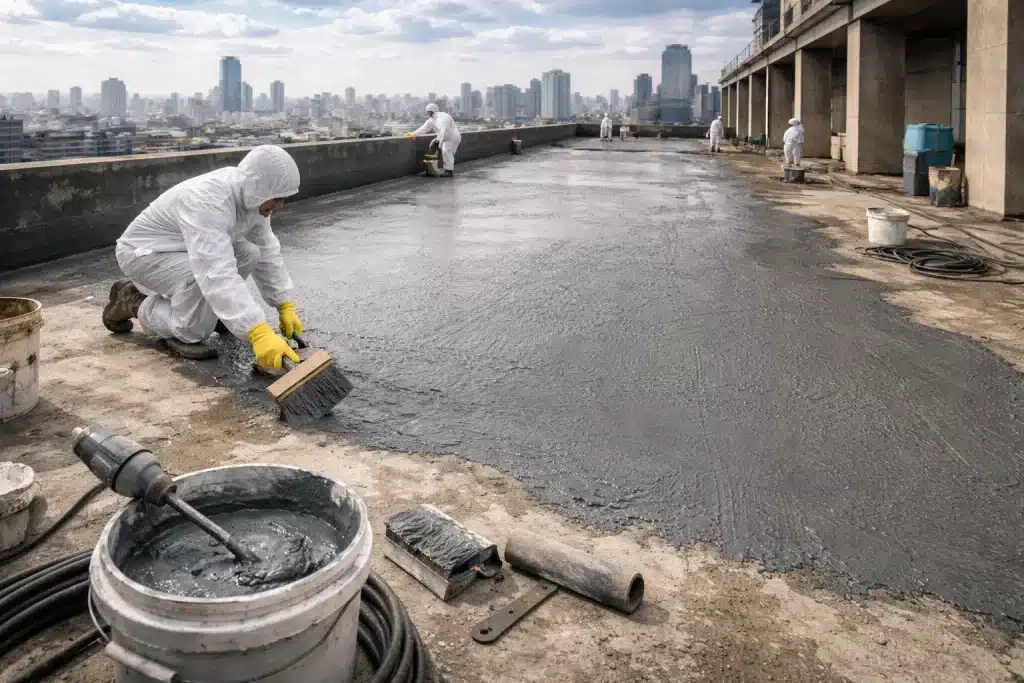
  • A cementitious waterproofing coating forms a continuous, pinhole-free film on the surface. Once applied, it develops into a tough, flexible membrane that resists water pressure while still allowing the substrate to breathe.

  • This dual capability waterproof yet breathable prevents blistering, reduces moisture buildup underneath the coating, and increases the lifespan of the structure.

Application Science: Where Projects Win or Fail

Substrate Preparation = 70% of Waterproofing Success

In 1K cementitious waterproofing, performance is governed less by product chemistry and more by substrate condition, moisture state, and application sequencing. Surface saturation, pore structure, and curing discipline directly influence crystal formation, adhesion, and long-term watertightness.

When applied with the right surface science and execution discipline, 1K cementitious systems deliver truly durable waterproofing.

Coating Thickness Dictates Protection

  • In 1K cementitious waterproofing, protection depends on achieved film thickness, not just coverage.
  • Insufficient thickness restricts pore blocking and reduces pressure resistance.
  • Uneven application creates weak points for moisture ingress.
  • Specified thickness ensures barrier continuity across pores and micro-cracks.
  • Multiple controlled coats improve durability and watertightness.

Fact- A beautifully mixed product, if applied unevenly, will fail earlier than an average-quality material applied professionally.

  • Proper curing is critical for 1K cementitious systems. Ignoring it can lead to dusting, microcracks, or early delamination, regardless of product quality.

  • Avoid direct sunlight, strong winds, or premature water exposure, and always use a curing membrane. A correct curing schedule ensures durability and long-lasting performance.

Curing: The Most Ignored, Most Expensive Mistake

·  Proper curing is critical for 1K cementitious systems. Ignoring it can lead to dusting, microcracks, or early delamination, regardless of product quality.

·   Avoid direct sunlight, strong winds, or premature water exposure, and always use a curing membrane. A correct curing schedule ensures durability and long-lasting performance.

Commercial Logic: Why 1K Cementitious Systems Make Long-Term Financial Sense

Low Material Cost + Low Skill Dependency

1K systems require only:

  • potable water
  • a mixing paddle
  • brush/trowel/spray setup

No primers, no catalysts, no hot works, no complex installers.

Predictable Coverage Rates

  • 2–3 mm = 2–3 kg/m² consumption
  • zero-chloride composition
  • no special storage beyond dry room temp

Zero VOC, Potable Water Friendly

This makes it ideal for:

  • water tanks
  • WTP/STP plants
  • swimming pools
  • food-contact surfaces (post curing)
waterproofing cementitious

Lifespan Performance: What You Can Expect in Real Projects

A well-applied 1K cementitious waterproofing system typically delivers 15–20 years service life under positive-side conditions and 10–15 years under negative-side pressure, depending on substrate quality

Their strengths include:
✔ exceptional carbonation resistance
✔ protection from chloride attack
✔ freeze–thaw performance
✔ resistance to salts and acidic gases
✔ protection from chloride attack
✔ Forms a dense, highly impermeable waterproofing layer
✔ Exceptional adhesion to concrete, ensuring a strong and lasting bond

The durability of a micro-screed + the barrier properties of a polymer membrane.

Conclusion:

Multichem has been delivering high-performance construction chemical solutions for decades, helping structures stay protected against moisture and water damage. Its 1K cementitious products- Multiguard Protect and LeakShield, provide reliable, durable, and easy-to-apply waterproofing for a wide range of applications.

With Multichem, property owners and contractors can be confident in choosing solutions that combine technical excellence with long-term performance, ensuring structures remain safe, dry, and durable for years to come.

FAQ:

1K cementitious waterproofing is a single-component, powder-based coating that requires only water for activation. Once mixed and applied, it forms a breathable yet watertight membrane that blocks water penetration while allowing trapped moisture to escape. This prevents dampness, peeling, and long-term structural damage.

These coatings are used for terraces, bathrooms, basements, water tanks, retaining walls, and swimming pools, wet areas. Because they bond extremely well with concrete, brickwork, and masonry, they suit both new construction and repair projects.

When applied correctly over a sound substrate, a high-quality 1K cementitious coating can last 8–12 years or more. Its longevity also depends on surface preparation, environmental exposure, and the quality of the top screed or protective layer.

Yes. It can reduce or stop minor seepage, dampness, and moisture penetration. For active or high-pressure leaks, it is often paired with plugging compounds, repair mortars, or injection grouts to ensure a complete solution.

Yes. It can reduce or stop minor seepage, dampness, and moisture penetration. For active or high-pressure leaks, it is often paired with plugging compounds, repair mortars, or injection grouts to ensure a complete solution.

Facebook
Twitter
LinkedIn
esd flooring

ESD Flooring That Protects Equipment, People, and Compliance

ESD Flooring That Protects Equipment, People, and Compliance A Practical Guide to Conductive & Static Dissipative Epoxy Floor Systems In electronics manufacturing, cleanrooms, defense facilities, and data-driven environments, electrostatic discharge isn’t a minor risk it’s a silent operational threat. One uncontrolled static discharge can: Damage sensitive electronic components Cause product

Read More »