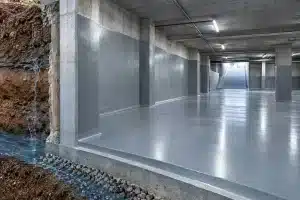
Epoxy Injection Grouting for Crack Repair- Restoring Concrete Structures

epoxy injection grouting

Factors such as shrinkage, thermal movement, overloading, corrosion of reinforcement, seismic activity, and poor construction practices can lead to cracks in concrete over time. These cracks, if left untreated, can risk structural integrity, water intrusion, corrosion and decrease the lifespan of the structure.

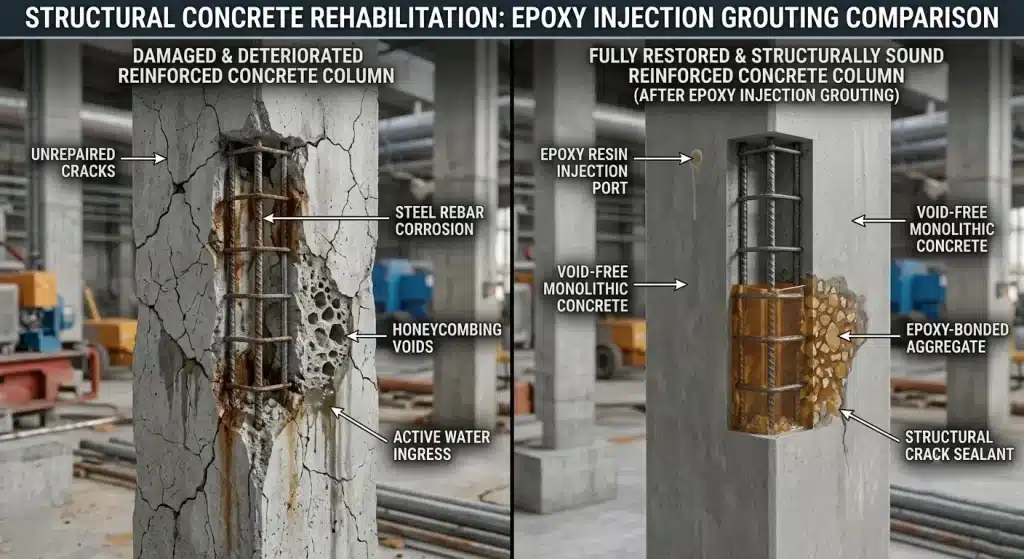
Epoxy injection grouting is one of the best ways to repair and reinforce broken concrete. It is a sophisticated repair method that can restore structural integrity, close cracks and enhance the durability of concrete components without extensive demolition/reconstruction.

What is Epoxy Injection Grouting?

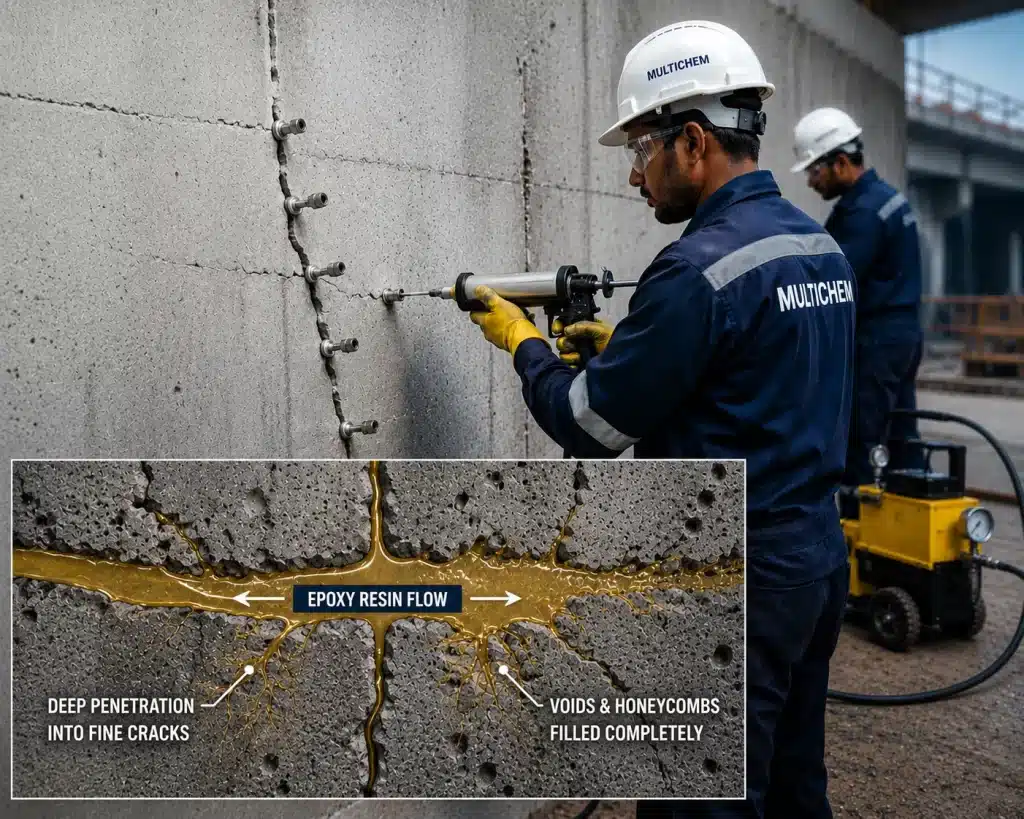
A repair technique that uses a low viscosity epoxy resin injected under pressure into cracks, voids and honeycombed concrete is called epoxy injection grouting.

The resin fills a great depth of the crack network and has a high bond capacity with the surrounding concrete, thus restoring the structural monolith.

Epoxy injection is performed from the inside of the structure and works to fill in any existing cracks, unlike the traditional repair mortars that are used primarily to fill surface defects.

Why Do Concrete Cracks Occur?

  • The shrinkage of plastic during the curing process.
  • Drying shrinkage over time
  • Thermal expansion and contraction
  • Settlement of foundations
  • Excessive loading or vibration
  • Corrosion of reinforcing steel
  • Seismic movements
  • Poor workmanship and inadequate curing

The first step in choosing a cracking repair method is to determine the cause of the cracking.

Benefits of Epoxy Injection Grouting

    1. Restores Structural Strength- Epoxy resins have high compressive and tensile strength, thus restoring almost all the original load-bearing capacity of the repaired section.


  1.  2. Excellent Penetration- Low-viscosity epoxy grout is able to penetrate the small cracks, micro-voids and inaccessible areas that traditional repair materials cannot reach.


  1. 3. Strong Bond with Concrete- Ultra strong bond with concrete for long-lasting durability and structural continuity.


  1. 4. Waterproof Sealing- The cured material makes it waterproof and keeps reinforcement from corroding.


  1. 5. Non-Shrink Performance- Epoxy grouts will not shrink during curing, which is an advantage over cementitious materials and eliminates the potential for secondary cracking.


  1. 6. Chemical Resistance- Epoxy systems are resistant to a range of chemicals, oils and industrial chemicals.


  1. 7. Quick Return to Service- Damaged structures can be returned to service quickly with the use of injection grouting.

Common Applications of Epoxy Injection Grouting

  • Concrete beams and columns
  • Suspended slabs
  • Bridges and flyovers
  • Parking structures
  • Industrial floors
  • Water-retaining structures
  • Basements and retaining walls
  • Tunnels and underground structures
  • Honeycombed concrete repairs
  • Crack repair in precast elements

Typical Epoxy Injection Process

Step 1: Surface Preparation

All dust, dirt, grease, loose particles and contaminants are removed from the crack area.

Step 2: Installation of Injection Packers

Injection ports or packers are installed along the crack line at predetermined intervals.

Step 3: Surface Sealing

To seal the leak path during injection, the exposed crack surface is sealed.

Step 4: Resin Mixing

The two epoxy parts are mixed as per the manufacturer’s instructions.

Step 5: Pressure Injection

The epoxy grout is forced in the crack under controlled pressure until it is filled.

Step 6: Curing

The injected resin is allowed to cure and develop its mechanical properties.

Step 7: Finishing

Packers are taken off and surface is worked out as needed.

Choosing the Right Epoxy Injection Grout

• Low viscosity for deep penetration

The viscosity is one of the most important properties of an epoxy injection grout. Low viscosity epoxy resins are designed to be fluid and can flow into narrow cracks, micro-cracks, voids and honeycombed areas in concrete. This penetration will fully seal interior imperfections and not just seal them on the surface. This results in continuity across the damaged area and reduced risk of future crack propagation.

• High bond strength

A good epoxy injection grouting should form a good bonding with the adjoining concrete substrate. High bond strength allows the injected resin to be used as a part of the structure itself instead of a filler substance. Such adhesion allows load transfer across the repaired crack, provides monolithic behaviour and enhances overall durability of the repaired concrete element.

• Good compression and tensile strength

Concrete structures are subjected to both compressive and tensile stresses during service. Therefore, epoxy injection grouts should possess sufficient compressive strength to withstand heavy loads and tensile strength to resist crack reopening. High mechanical strength allows the repaired section to regain its structural performance and withstand operational stresses without failure, making the repair suitable for structural applications.

• Non-shrink characteristics

The shrinkage of traditional repair materials can cause internal stress and debonding or re-cracking during the curing process. Epoxy injection grouts are formulated to shrink very little during cure, so that the crack is completely filled after they have cured. This non-shrink property facilitates a stress free repair, increases long-term stability and increases the effectiveness of the restoration.

• Chemical resistance

Industrial plants may contain chemicals, oils, fuels, solvents, salts and other corrosive materials, which can be harmful to concrete. These contaminants do not cause deterioration to the repaired area because they are protected by an epoxy grout that is very resistant to chemicals. It is particularly useful in factories, chemical plants, wastewater treatment plants, warehouses and industrial flooring projects where it is likely to come in contact with corrosive substances.

• Moisture tolerance where required

Some cracks will not be 100% dry when they are mended. Residual moisture can exist in concrete in basements, tunnels, retaining walls, water-retaining walls, and underground facilities. Epoxies designed for moisture-tolerant performance are specially formulated to ensure adhesion and curing even in the presence of moisture in the substrate. Choosing the right moisture resistant grout can make the difference in successful repairs in difficult site conditions.

• Suitable pot life for site conditions

Pot life is defined as the period of time between mixing the epoxy and when the epoxy starts to harden. A contractor will be provided enough time to complete the grout injection process with an appropriate pot life and material wastage will be reduced. The pot life required will vary depending on ambient temperature, crack volume, injection equipment and project complexity. Selecting a product with a suitable working time will ensure smooth product application and consistent product application.

The right product can significantly influence the durability and effectiveness of the repair.

Conclusion

Epoxy injection grouting remains one of the most reliable and proven methods for repairing cracked concrete structures. Its ability to restore structural integrity, seal water pathways, and provide long-term durability makes it an essential solution in modern concrete repair and rehabilitation projects.

By selecting high-quality low-viscosity epoxy injection systems and following proper application procedures, engineers and contractors can extend the service life of structures while avoiding costly replacements.

Multichem's Epoxy Injection Grouting Solutions

For professional crack repair and structural rehabilitation, Multichem offers specialized epoxy grouts under the PRIMEGROUT range:

  • PRIMEGROUT UltraFILL-200 – High-performance low-viscosity epoxy injection grout designed for deep crack penetration, high strength development, and structural repairs. It offers excellent flowability, strong adhesion, non-shrink performance, and waterproof sealing.
  • PRIMEGROUT UltraFILL-300 – Moisture-insensitive low-viscosity epoxy injection grout suitable for filling cracks, honeycombed concrete, and structural voids. It provides excellent bond strength, waterproofing properties, chemical resistance, and durable repairs even in challenging conditions.
  • PRIMEGROUT EP150 is a high early-strength, non-shrink epoxy grout that ensures precision alignment, superior load transfer, and long-lasting support for heavy machinery and critical structural applications. Its solvent-free, chemical-resistant formulation delivers exceptional durability, creep resistance, and reliable performance even in the harshest industrial and marine environments.
  • PRIMEGROUT EP350 is a high-strength, low-exotherm, non-shrink epoxy grout engineered for precision machinery alignment and permanent structural support under demanding load conditions. Its solvent-free, three-component formulation delivers exceptional bond strength, chemical resistance, and durable performance on concrete and steel, making it ideal for critical industrial applications.

These advanced epoxy injection grouts are engineered to help contractors, consultants, and asset owners achieve durable and reliable concrete repair solutions for residential, commercial, industrial, and infrastructure projects.

FAQs

Epoxy injection grouting is used to repair structural cracks, honeycombed concrete, and internal voids in concrete members. It is ideal when restoring the strength and integrity of the structure is the primary objective.

Yes, epoxy injection seals cracks and prevents water ingress. However, for actively leaking cracks, PU injection is often preferred first, followed by epoxy injection if structural strengthening is required.

Low-viscosity epoxy can penetrate deep into fine cracks, micro-cracks, and hidden voids within concrete. This ensures complete filling and a more effective, long-lasting repair.

Yes, epoxy injection creates a strong bond across the crack and helps restore load transfer within the concrete member. This makes it one of the most effective methods for structural crack repair.

Epoxy injection grouting offers excellent adhesion, high strength, non-shrink performance, waterproof sealing, and chemical resistance. It also helps extend the service life of damaged concrete structures.

Epoxy injection is mainly used for structural repairs where strength restoration is needed, while PU injection is primarily used for waterproofing and sealing active water leaks due to its flexible nature.

Facebook
Twitter
LinkedIn
epoxy injection grouting

Epoxy Injection Grouting for Crack Repair- Restoring Concrete Structures

Epoxy Injection Grouting for Crack Repair- Restoring Concrete Structures Factors such as shrinkage, thermal movement, overloading, corrosion of reinforcement, seismic activity, and poor construction practices can lead to cracks in concrete over time. These cracks, if left untreated, can risk structural integrity, water intrusion, corrosion and decrease the lifespan of

Read More »